



Jefferson Countians will have an added mental health resource when Compass’ Behavioral Health Crisis Center opens this summer in Festus.
The center, which will be housed in a space in the upper level of 222 N. Mill St., will be the first crisis center in Jefferson County, but it will be Compass’ fifth center in Missouri.
“The goal is to open the crisis center in August, and it is dependent on hiring staff,” said Sue Curfman, Compass’ regional senior vice president of corporate services.
The crisis center will provide 24/7 care for adults experiencing a crisis, with a goal to connect them with community-based care, avoiding both hospitalizations and unnecessary law enforcement engagement, Curfman said.
After someone seeking help is checked in at the crisis center, the person will meet with a nurse and a triage clinician in a private triage room, said Lauren Bruce, senior director of the behavioral health crisis centers.
Together, the nurse and clinician will come up with a plan that may include other care providers. Some people will be admitted while others will be connected to services, she said.
Bruce said a person may be admitted for up to 23 hours. The length of stay is a little more flexible for residents who are in active withdrawal.
The center is not a detox facility, but its staff will help the person until a bed is available at a treatment center.
To be admitted, Bruce said, the patient must meet three conditions. The patient must be at least 18 years old (juveniles cannot be admitted) and ambulatory (within reason), and the admittance must be voluntary.
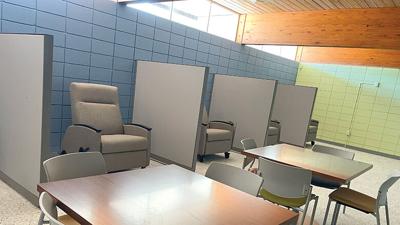
The center includes a large, open room with eight recliners, as well as additional seating, where people will go to relax, take a nap, work a puzzle or watch television. For those overstimulated or in need of privacy, a quiet room also will be available.
Bruce said the center will have a psychiatric prescriber on staff to prescribe or bridge medicine for a couple of days at no cost.
She said staff can also help people sign up for Medicaid, if needed.
Bruce said she has seen all kinds of reasons people seek help at a crisis center, including substance abuse; suicidal/self-harm/homicidal thoughts; domestic violence; housing displacement or even parents in crisis over a custody battle.
“We work to connect you with whatever that next step may be,” she said.
Discharged patients leave the center with a personalized care plan and an assigned caseworker who will follow up with them for 30 to 90 days, Bruce said.
The center has a “No Wrong Door” policy where people are not turned away, she said.
“We’re not going to tell you that we can’t help with your problem,” Bruce said. “We might not be the right place for that problem, but we’re going to come alongside you. We’re going to do the research with you. We’re going to help make phone calls.
“For example, the individual who came in with a child support issue. They needed legal services, in addition to what we were providing, so rather than say, ‘Well, here’s a phone number, do some Googling for an attorney,’ (we say), ‘Let’s Google it together.’ Probably every day we have a situation where I’m like, we’ve never had that before.”
Those in crisis may take a hot shower, get a fresh set of clothes and even a meal, if needed.
Comtrea merged with Compass in July, and Curfman said she began talking with Mercy Hospital Jefferson and the Jefferson County Sheriff’s Office the next month about a crisis center.
Without a crisis center like the one to open soon, people experiencing a mental health crisis outside normal business hours either end up at Mercy Jefferson’s emergency room or at the jail, she said.
“On any given night, there are five to eight people,” Curfman said.
She said the crisis center will assess and connect people with services while respecting the humanity of the person.
Curfman said law enforcement and mental health providers are excited about the center opening.
“Compass has brought so much to this county,” she said.
Bruce said Compass already has arranged with ambulance providers across the state to make sure transportation is available to take people to crisis centers when virtual services aren’t enough.
“The barrier we noticed when we first (started opening crisis centers in Missouri) is that people were calling, and they were open to come into the crisis center, but they had no transportation,” she said.
“We were calling EMS asking for transportation and they didn’t have the rules in place to transport to us, so there’s been a big initiative and push from our leadership across the state to not only change the EMS regulations to allow transportation to an alternative location, but also to allow reimbursement. So that’s been really great, really exciting, and again it gives EMS another option. The only barrier we’re working through right now is some departments have different internal policies that they’re working to change in order to facilitate, but the state has changed all their rules to help it with that.”
The crisis center takes on the responsibility to get the individuals back to their home community.