



The Big River and North Jefferson County ambulance districts will try again on Aug. 2 to get voter approval for bond issues that officials at both districts say will ease the overall financial stress they’re facing.
Big River Ambulance is seeking a $17 million bond issue, while the North Jefferson County Ambulance District is asking for a $21 million bond issue. Both issues would require a tax increase and are named Proposition Safety and require a four-sevenths majority for passage.
The two ambulance districts tried identical ballot issues in April and, while both had more district residents vote yes than voted no, both fell short of the four-sevenths majority requirement.
In April, Big River voters cast 1,660 yes votes, or 53.65 percent, to 1,434 no votes, or 46.35 percent.
North Jefferson County’s residents cast 1,687 yes votes, or 54.99 percent, to 1,381 no votes, or 45.01 percent.
Officials for both districts say they do not intend to sell the entire amount of bonds all at once and may not ever sell all of them, but instead would phase in selling the bonds and, in turn, phase in the increase in taxes required to pay them off.
Big River Ambulance
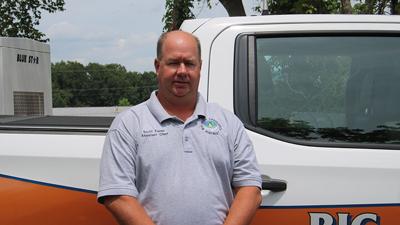
If Proposition Safety passes, the district will sell between $5 million and $6 million in bonds immediately, which would allow it to replace aging House No. 1, 6321 Lorens Lane, in Cedar Hill, and replace some equipment, Chief Scott Fisher said.
“When we bought House No. 1 in 1975, it was an old auto body place,” Fisher said. “It’s getting to the point where it’s not livable, and we’re going to have to consider shutting it down, which means we’ll be running all of our calls to Cedar Hill and Dittmer out of our House Springs office (6969 Wild Cherry Drive), which will decrease response times to those areas.”
Fisher said House No. 1 has a mold problem, and it’s no longer suited for the district’s purposes. “The training area is the same place where they take care of patients, and watch TV and eat. The space is very limited,” he said.
Fisher said some money from the bond issue would be used to replace its fleet of three ambulances.
“All of them have more than 100,000 miles, and while yes, they’re diesel, they’re also running on back roads and long driveways that are gravel.”
He said the air-conditioning unit recently went out in one of the ambulances.
“We had to cover a 125-square mile area with two ambulances,” he said.
Other money from the initial bond issue would be used to replace outdated equipment, Fisher said.
Eventually, he said, money freed up from the general operating fund used to maintain House No. 1 will be used to hire as many as three more full-time paramedics and improve the salaries for the 12 full-timers now on staff, which he said are the lowest paid in the county.
“That would get us to three full-time personnel on each shift,” he said. “Right now, we rely heavily on our 19 part-time paramedics.”
Fisher said the initial sale of $5 million to $6 million in bonds likely would raise the district’s current tax rate of 27.21 cents per $100 of assessed valuation by 6 cents.
The owner of a house valued at $150,000 by the county Assessor’s Office would pay $17.10 more per year in property taxes.
Fisher said the district likely will sell another $5 million to $6 million in bonds in five years, in part to renovate the other two houses at 4795 Tishomingo Road in Hillsboro and the House Springs facility, and money that would be freed up might be used to hire three additional full-time paramedics, which he said would be an ideal number.
The remainder of the bond issue, if needed, would be sold in about 10 years, he said, and at current rates would add a total of 18 cents to the district’s tax levy, or $51.30 more per year in property taxes until the first set of bonds are retired.
Fisher said the district’s board members figured they would try their Proposition Safety again with a different strategy.
“We were only 106 votes from passing,” he said. “We had a majority.”
Fisher said the consensus was that in April, the district relied too much on social media to get its word out.
“We put a lot of information out there, but I’m not sure that many of our residents are active on social media,” he said.
This time around, Fisher said, the district will send a letter to voters.
“We’ll tell them why we need this money and what and when we intend to spend it,” he said.
The district’s 125 square miles take in House Springs, Cedar Hill, Morse Mill, Dittmer, Ware, Grubville and Byrnes Mill.
North Jefferson County Ambulance
Chief Jamie Guinn said the situation is similar in the North Jefferson County Ambulance District, where a swing of 64 votes in April would have made Proposition Safety a winner.
“We’re trying it at the next election because our needs haven’t changed,” he said. “If we can pass Proposition Safety, we’ll be on relatively solid financial footing for the next 20 years.”
Guinn said Proposition Safety would be used to replace aging, outdated equipment.
He said two of the district’s four ambulances have logged more than 100,000 miles and a third is fast approaching that mark.
“The cost of an ambulance has gone up over the last few years from about $150,000 to in the $260,000 range, and that’s before you equip it,” he said. “We need new heart monitors and lifts.
“The cost of everything involved in emergency medical service is going up with inflation. Most of our equipment has an eight-year life expectancy, and we’re exceeding that with many things.”
Guinn said the board plans to sell about $4.5 million in bonds in four increments over the next 20 years, but he did not have an estimate on how much the initial sale would affect the district’s current tax rate, which is 26.95 cents per $100 of assessed valuation.
He said in April, if the entire $21 million of bonds are sold, it would likely increase the tax rate by 23 to 26 cents, so the immediate increase would be 6 to 7 cents.
If the bonds trigger a 6-cent tax increase, the owner of a house valued at $150,000 by the county Assessor’s Office would pay $17.10 per year in property taxes.
In addition, Guinn said, the first sale of bonds would be used to retire the debt incurred by building House No. 2 in 2016. That house is at 1130 Gravois Road in the Murphy area in unincorporated Fenton.
He said retiring that debt would free up about $250,000 per year from the general operating budget that can be used for other issues.
Guinn said the district also is fine-tuning its message delivery this time around.
“I think we relied a little too much on social media in April,” he said. “This time, we’re sending out a mailer that will include the facts for voters to decide. We will also have information on Facebook and our website. We’re also arranging a couple of coffee days with the chief, where our residents can come in and have a question-and-answer session with me. We’ll be announcing those dates on our website. And, of course, we’ll have people at the polling places on Election Day to answer any questions.”
The district covers about 32 square miles in the Fenton and High Ridge areas.