


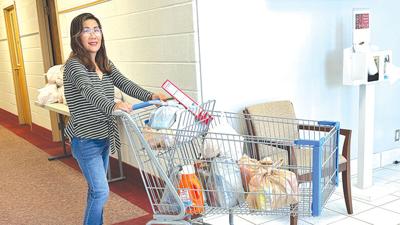

The Jefferson County Hunger Task Force (JCHTF) has resumed fundraising and planning food drives after a three-year hiatus that began during the COVID-19 pandemic.
“Our goal is to generate more volunteers, interest and donations for our food pantries,” said Suzan Weller, chair for the JCHTF. “Every little bit helps.”
The task force’s revived efforts come none too soon, according to those who run the food pantries that are part of the coalition.
Directors at those local food pantries say more and more people are seeking help to put food on their tables as food costs increase.
In order to better help the food pantries, the JCHTF needs to replenish its coffers, which were depleted in May 2020 when it doled out $25,000 to its member food pantries that were struggling to provide food for people who lost their jobs during the pandemic.
“The main problems facing our food pantries are limited funding and the high cost of food,” said Weller, who’s also executive director for the Disability Resource Association. “Likewise, individuals cannot afford the cost of food due to inflation and the long-term impact of the COVID pandemic. At the same time, their other bills, such as rent, utilities and medications, have also increased.”
The JCHTF helps 16 Jefferson County food pantries. More than half of those pantries are run by churches. All depend on volunteers and donations to help them serve anywhere from 160 to more than 1,000 clients a month.
Arnold Food Pantry
So far this year, the Arnold Food Pantry, which is open daily and serves nearly 13,000 people annually, has served more people than the previous year, executive director Ed Fitzhenry said.
“The number of people we serve began increasing in June and is up about 15 percent,” he said. “A lot of variables drive increased visits, and I can’t explain the reasons for this, though clearly inflation and food costs are contributors.”
Founded in 1983, the Arnold Food Pantry was one of the first food pantries in Jefferson County and currently serves more than 1,000 clients a month who live in Arnold, Imperial, Barnhart and Fenton, as well as portions of South St. Louis County.
“We give away food totaling about $2.3 million a year, probably closer to $3 million,” Fitzhenry said. “We allow clients who are signed up to come twice a month. We provide substantial food, so they receive 10 meals that cover 14 days on each visit. Altogether we give $600 of food per month for one to two people. We are generous with meat that includes ground turkey, beef, roasts, chicken and steaks.”
Eligibility is based on a formula linked to the poverty level.
“Our formula takes into consideration a person’s gross income from Social Security, disability, wages, unemployment and SNAP,” he said. “If the poverty level is $15,000, we double that allowing someone to have an income of $30,000. Very few of our clients receive SNAP benefits.
“About 70 percent of our clients are over age 54 or under age 18. They are either on fixed incomes or unable to fend for themselves by getting a job.”
To meet food demand, the Arnold Food Pantry participates in Operation Food Search and the St. Louis Area Foodbank, with 80 percent of its food coming from local stores throughout the St. Louis area. Volunteers visit grocery stores daily to pick up excess inventory and food nearing expiration dates. Donations come from churches and civic organizations, and grants include the Jefferson Foundation. The Food Pantry also gets revenue from sales at the Treasure Shoppe thrift store located next door.
First UMC of Festus-Crystal City Food Pantry
Meanwhile, the smaller food pantry at First United Methodist Church (FUMC) of Festus-Crystal City also has seen a significant increase in clients since the pandemic, director Beth Haberer said.
“Before the pandemic, we were serving around 20 families each week,” she said. “That number keeps growing, and now it is not uncommon for us to serve 30 to 40 families weekly.”
In 2022, according to the Census Bureau, an estimated 8.7 percent of Jefferson County residents lived in poverty, defined as having an annual income of $13,590 for an individual, $18,310 for two people and $27,750 for a family of four.
Closely tied to poverty is the number of people who receive Supplemental Nutritional Assistance Program (SNAP) benefits, or food stamps, from the Missouri Department of Social Services. Income may equal 130 percent of the federal poverty level to qualify for SNAP.
In September, 8,198 households, or 16,848 people, in Jefferson County received $3.25 million in SNAP benefits. The ongoing need for food support is reflected in the 1,248 applications county residents submitted for SNAP benefits in September, of which 774 were approved and 474 were rejected, according to the Missouri Department of Social Services’ monthly management report.
Those who don’t have enough money for food often make poor nutrition decisions, said Brianne Zwiener, spokeswoman for the Jefferson County Health Department.
“Surveys collected at Project Homeless Connect found that discount stores and gas stations were used regularly to buy food,” she said. “Money was an issue, and fast food was the convenient and affordable option.
“Supermarkets traditionally provide healthier options than convenience stores or smaller grocery stores. A lack of access to fresh fruit and vegetables is related to premature mortality, and nutritional insecurity is correlated with a higher prevalence of obesity and premature mortality.”
Meanwhile, the Jefferson County food pantries try to provide nutritional security on shoestring budgets.
The Jefferson Foundation provides financial support to a wide range of charitable organizations throughout the county, including 23 food pantries, and Haberer credits the foundation with helping the FUMC food pantry stay in business. In 2023, the pantry received a $10,000 grant for food and a new proactive grant for $8,000 to help with inflation.
“We would not be able to keep going if not for the proactive grant,” she said. “We receive donations in food and money from church members, businesses and Operation Food Search in St. Louis, yet we must supplement these donations to make ends meet.”
At the FUMC food pantry, it is business as usual on Tuesday the week before Thanksgiving, where a line of cars begins forming at 6:30 a.m., two hours ahead of its opening. Haberer checks with clients to be sure they are registered and receive their shopping list from a preprinted form.
Inside the church, volunteers fill bags with groceries and wheel carts filled with those bags of groceries to the clients’ vehicles. Each recipient may visit one time a month and receives enough food for three days for each person in the family.
“Traditionally, our pantry served more older adults, but lately adults aged 19 to 54 have surpassed them,” Haberer said. “When clients register, we ask that they be SNAP eligible to receive food from the pantry. Most of our clients live on $700 to $1,200 a month. Many of them tell me, ‘I only come here when I absolutely need food.’”
Brenden’s Friday Backpacks
The Brenden’s Friday Backpacks organization fills the nutritional gap for Jefferson County schoolchildren by providing weekend food for those who otherwise might miss meals. Each week, about 20 volunteers help to sort, pack and deliver a total of 1,717 bags of food to schools across Jefferson County. The program serves every school in the county, from early childhood to high school, except for Crystal City, which has its own program.
“This is the largest number of children we’ve ever served,” said Vicki Tamboli, whose son, Brenden Tamboli, started the program in 2011 as his Eagle Scout project and who continues as a volunteer delivering bags to schools. “The challenges for us are having enough money and the economy. Just like consumers, we do not get discounts on food, except for our tax-exempt, nonprofit status.
“We work off donations of food and money, fundraisers that are often organized by our supporters and grants from the Jefferson Foundation and small businesses.”
Nationwide, the U.S. Department of Agriculture reports that 13 million children, 18.5 percent, live in food-insecure households.
“These kids often don’t know where their next meal is coming from,” Tamboli said. “They may be with one parent during the week and go to the other parent’s house on the weekend where there is no food.”
The Jefferson County Hunger Task Force, which is taking the lead to fight food insecurity, needs help to fulfill its motto, “Let no one go hungry in Jefferson County.”
It is seeking volunteers, donations and participation in upcoming fundraising efforts.
JCHTF fundraisers on tap
The JCHTF will hold a Nov. 29 fundraiser at the Texas Roadhouse in Arnold and another on Dec. 20 at the Texas Roadhouse in Festus. Each of the restaurants will donate 10 percent of its sales from people who dine that day and show their servers a print or digital promotional flyer available on the Disability Resource Association Facebook page.
Food drives are planned for 2024.
Donations to benefit the Jefferson County food pantries can be sent to JCHTF, c/o Disability Resource Association, 130 Brandon Wallace Way, Festus, MO 63028. You may call 636-931-7696 for more information.