



Eureka will give a nod to its recent past while celebrating its 70th anniversary as an incorporated city.
A Concert on Central event will be held at 6 p.m. Friday, June 14, in Eureka’s Old Town. It will be the first concert held on Central Avenue since the city moved the annual event to the Spur, 394 S. Central Ave., in 2021.
The concert series had been held on Central Avenue for more than a decade prior to the move, city officials said.
“It’s like we’re kind of going back to our roots of what we used to do,” Parks and Recreation Department supervisor Lizzie Roberds said. “I’m very excited.”
The concert is the only city-planned event to celebrate Eureka’s anniversary. It was incorporated as a city on April 7, 1954.
Kathy Butler, a lifelong resident and the city’s attorney, said Eureka’s incorporation was done out of necessity. Her father, Ralph C. Butler, owned Butler Electrical Contracting at 200 S. Central Ave. and was an alderman when Eureka became a city.
“(Eureka) is the western-most city that’s wholly in St. Louis County,” Butler said. “One of the reasons (to incorporate) is response times. If you’re in unincorporated St. Louis County, it’s a long time to get (emergency services) to respond as opposed to Eureka’s response time, which is minutes. It would be 30 minutes or more anytime that we’d call for unincorporated assistance.”

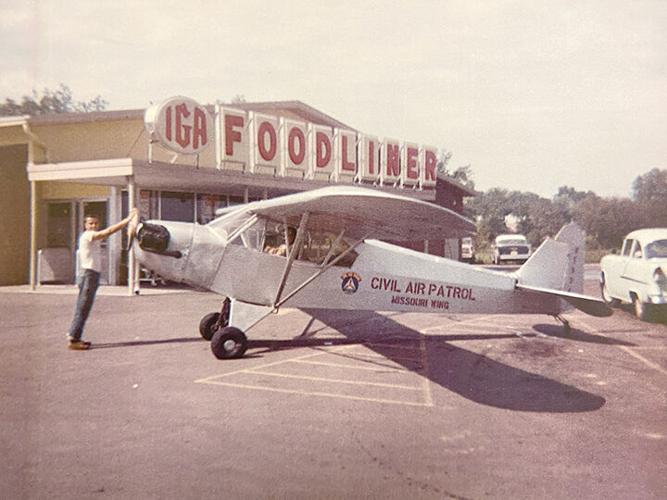
A civil air patrol plane parked at the IGA Foodliner grocery store once located at 225 Thresher Drive in the 1960s. The space now houses Lindell Bank.
The Eureka Police Department was established in 1958. The Eureka Fire Protection District transitioned from a volunteer force to a tax-supported entity with paid, full-time staff in 1971.
Mayor Sean Flower said Eureka has grown a lot in the last 70 years. He said the area has shed its farm-town reputation, but it has not lost its close-knit feel.
Flower said his family moved to the city in 2002 because of Eureka’s housing options, plethora of young families, its downtown area, and residents’ civic pride.
“Sometimes when you’re driving through St. Louis County you can’t really tell when you left the boundary of one city and enter another,” he said. “One thing that’s unique about Eureka is that people will tell you they’re from Eureka, they know the area, and a lot of the families that are here have been here a long time.
“The biggest thing is it’s a community that people stay here, they raise their families here and they give back to the community.”
The name
Drew Walters, one of 12 members of the Eureka Historical Society, said the city was a farming community for most of the 19th and early 20th centuries.
The city began to transform and was christened Eureka when the Missouri Pacific Railroad started laying railroad tracks in the area to connect Pacific to Kirkwood in July 1853.
According to the city’s website, eureka.mo.us, when builders of the railroad track came around the bend on the east side of the present site of Eureka and looked westward at the level land with no rocks and very little dirt to move, they cried out, “Eureka!”
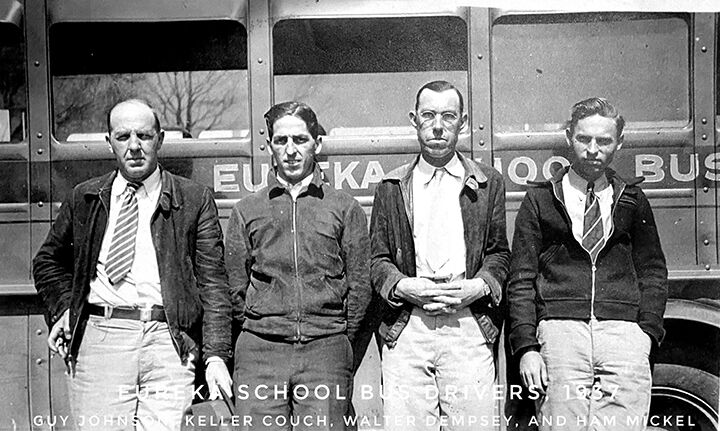
Eureka School bus drivers in 1937, from left, Guy Johnson, Keller Couch, Walter Dempsey, and Ham Mickel.
The St. Louis-San Francisco Railroad laid its railroad tracks through downtown Eureka in the 1870s, and by 1890, Eureka was a village of about 100 homes, Walter said.
One of the most notable periods of development stemmed from the construction of Route 66, or Hwy. 66, through Eureka in 1931. The highway connected Chicago, Ill., to Santa Monica in Los Angeles County, Calif., by traveling through Illinois, Missouri, Kansas, Oklahoma, Texas, New Mexico and Arizona.
Walters said restaurants, hotels, and gas stations began to crop up along the highway. He said most of the original businesses along Hwy. 66 were demolished when construction began on I-44 in 1962.
County oasis
In the 1920s, Walters said Eureka developed a reputation as a getaway destination for St. Louis residents. Resorts were set up along Hwy. 66 advertising fresh air, beautiful parks and access to swimming holes.
Walters said the Famous-Barr (established in 1910) and Times Beach (established in 1925) resorts were the most popular at the time. Famous-Barr was a retreat for employees of the St. Louis department store and operated in Eureka until 1942. The area is now Beck Park, which is in the Jefferson County portion of Eureka.
“Famous-Barr was like, this perfect place for a retreat because it’s out of the city where the workers lived at the time,” Walters said. “All of the ruins of the resort are still there. I would love to see the ruins more preserved. Anyone can just drive up to the park and explore it, but it’s in bad shape right now.”
Times Beach was incorporated as a city seven days after Eureka, on April 14, 1954, following many years of growth credited to travelers passing through on Hwy. 66. While the grounds holding Famous-Barr were abandoned over time, residents at Times Beach were forced to evacuate in 1982 due to dioxin contamination.
Major developments
Following the end of World War II, Eureka underwent major construction projects. In the first year as a city, under the leadership of Mayor Irvin “Doc” E. Drewel, streetlights were installed and construction for a water system was initiated. The city’s first suburb, Shaws Garden on Bald Hill Road, was built in 1959. Augustine Heights was constructed shortly after, Walters said.
He said Shaws Garden was built for workers at the Chrysler St. Louis Assembly Plant in Fenton.
Butler credited the plant for kickstarting much of Eureka’s growth.
“I think one of the biggest developments in Eureka was the Chrysler plant because a lot of folks lived in Eureka and worked at the plant,” she said. “A lot of the subdivisions were developed because people lived in Eureka and worked in Fenton.”
Walters said Eureka was hurt by the development of I-44 and Hwys. 66 and 109.
“Downtown Eureka was bypassed three different times – with Route 66, I-44 and Hwy. 109 – and that kind of hurt businesses,” he said.
Butler said I-44 cut Eureka in half. She said the city has little say over how the interstate and highway were developed and how they are maintained because those roads are owned by the Missouri Department of Transportation.
“You’ve got all these major roads going through your city but you don’t really have any control over them,” she said. “That makes it difficult to control development and deal with a lot of the things going on.”

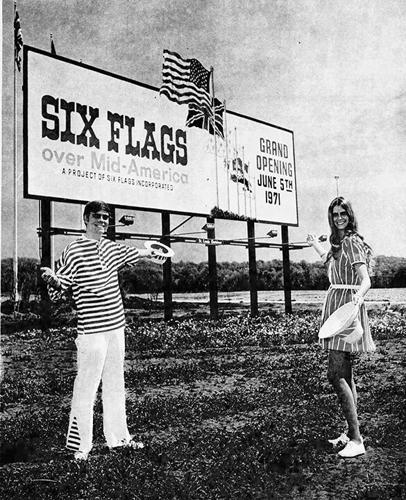
An advertisement for Six Flags St. Louis in the Sunday, May 20, 1971, edition of the St. Louis Post-Dispatch.
The establishment of the Six Flags amusement park in 1971 helped re-establish Eureka as a destination in St. Louis County, Walters said.
He said the park was the first of its kind in the St. Louis area, and its Old Glory Amphitheater attracted major star power to Eureka. The Amphitheater stopped having regular shows in 2006.
“A lot of famous people came through here and dined at our restaurants – New Kids on the Block, The Monkees, The Beach Boys,” Walters said. “A lot of big bands played at the amphitheater, and I hope one day Six Flags recognizes the history of it because it brought a lot of people in here. I think that’s also partly why it closed because it caused so much traffic on I-44 and West Fifth Street.”
Flower said the amusement park helped attract hotels, restaurants and other businesses to the city.
“Keeping Six Flags has been a big deal,” he said. “Being able to maintain Six Flags, by drawing them out and keeping them here, that’s what attracted some of these early, staple restaurants like Joe Boccardi’s.”
Today
Flower said despite Eureka’s growth, residents have continued to have a tight-knit relationship. He said that community bond was shown during floods in 2015 and 2017.
“One thing that stands out to me is the city’s reactions to big events, like flooding,” Flower said. “We’ve had people volunteer to help out with big sandbagging events. You really do see a lot of the quality in the people who live here.”
Flower said Eureka will continue to evolve with some major projects expected to be completed in the next few years.
The city is building the Michael A. Wiegand Justice Center, which is named after the Eureka Police chief. The building will house Eureka’s City Hall, Police Station and municipal court.
It is expected to be finished this winter.
A new Allenton Bridge also will be constructed to replace the current crumbling bridge and connect the Allenton area to I-44 and the rest of Eureka.
The city is financing those projects with revenue from Proposition E, a 1/2-cent sales tax voters approved in April 2018.
Flower also said Eureka is expected to be the home for more baseball and softball tournaments because the city recently completed renovating fields at Lions and Legion parks.
“I’m also seeing a lot of interest from retail stores and developers to bring more amenities and services out to the city because our population has kind of hit a line where people are starting to notice we’re on the map,” he said. “Frankly, they know the city is a pretty good place to work and I feel we’ve started to get a pretty good reputation as a place where a lot of businesses want to go.
“I think we’ll see some significant new faces in the city in the next couple of years.”