


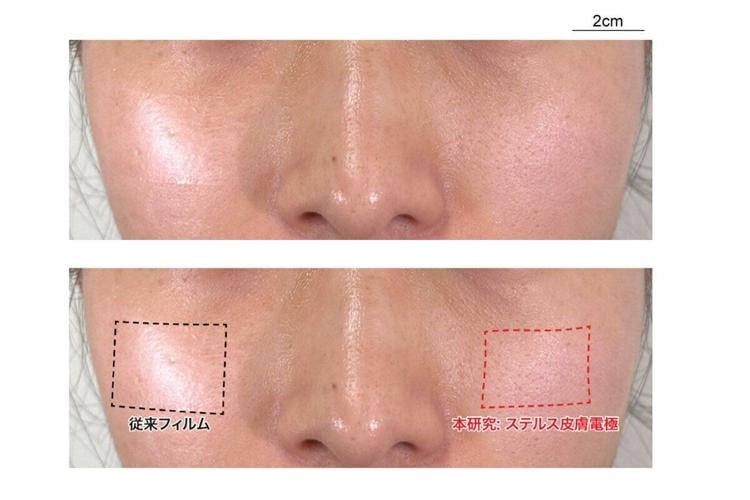




Researchers from the Institute of Industrial Science, The University of Tokyo have developed ultrathin wearable sensors that blend seamlessly into skin, reducing discomfort and distraction. (Institute of Industrial Science via SWNS)
By Stephen Beech
Invisible skin sensors 500 times thinner than a human hair will "revolutionize" health monitoring, according to new research.
The ultra-thin devices developed by Japanese scientists can't be seen by the naked eye - even if worn on the face.
Wearable health sensors - from fitness trackers to medical-grade biosensors have become commonplace for tracking vital signs, biochemical levels and activity.
But they can be awkward to wear in some circumstances. For example, devices attached to the face can draw unwanted attention, increase self-consciousness and influence the very signals users are trying to measure.
But new research in Japan, published in the journal Science Advances, may have found a solution by introducing ultrathin sensors that can't be seen by observers or felt by the wearer.
A team from the University of Tokyo's Institute of Industrial Science and other institutions has come up with thin, stretchable on-skin electrodes that are effectively invisible when worn on the face.
They say the new technology can measure biological signals while remaining undetectable by eye and by touch, allowing monitoring to take place under more natural conditions.

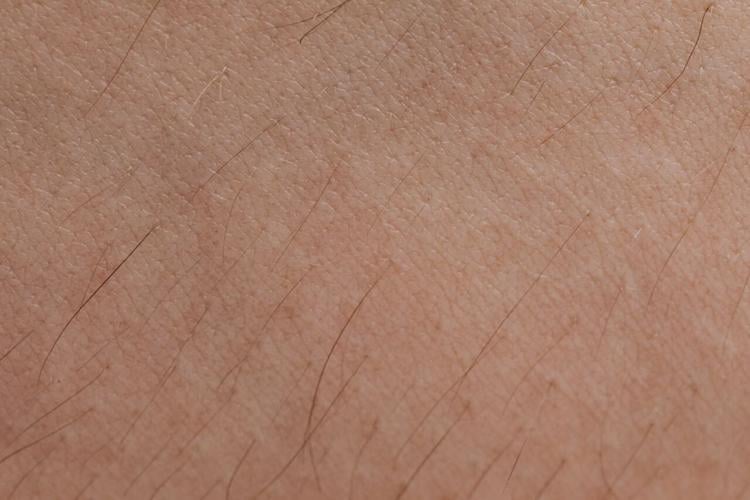
(Photo by kaboompics via Pexels)
Biosignals - such as eye movements, facial muscle activity and brain activity - provide valuable information for healthcare monitoring and human–machine interaction.
But conventional facial electrodes can alter a person's appearance and affect social interactions, creating what are called "appearance artifacts" – changes in behavior or psychological state caused simply by wearing a device the individual and others can see.
Study senior author Naoji Matsuhisa, from the University of Tokyo, said: "To truly integrate wearable electronics into daily life, they need to disappear into the background.
"People should be able to wear sensors without feeling watched, judged, or uncomfortable."
He says the new electrodes achieve that by combining several design features, including an ultrathin elastic film around 200 nanometers thick - 400 to 500 times thinner than a typical human hair - and transparent conductive nanowires.
The resulting device closely matches the appearance and texture of natural skin, reducing reflections and eliminating the glossy appearance that often makes wearable electronics noticeable.
Study lead author Yijun Liu said: "In our experiments, neither wearers nor outside observers could reliably detect the electrodes by sight or touch.
"The devices remain comfortable and breathable during use and work across a wide range of skin tones and features."
The findings show that the electrodes still perform their intended function.

(Photo by Los Muertos Crew via Pexels)
The team successfully recorded electrooculography signals from eye movements, electromyography signals from facial muscles and electroencephalography signals from brain activity using the electrodes.
For several signal types, the signal quality was measurably better than that obtained using conventional gel electrodes, owing to lower skin impedance.
Matsuhisa said: "By making wearable electronics that are both fully functional and effectively invisible, we are moving one step closer to a future in which health monitoring and human–machine interaction are seamlessly integrated into everyday life."
The Japanese team believes that future applications of their sensor could include subtle monitoring of emotional state and cognitive function, as well as new ways to control devices or virtual-reality systems using eye movements and facial expressions.
Matsuhisa added: "More broadly, invisible sensors like these could help create a future in which technology adapts seamlessly to people, rather than the other way around."