


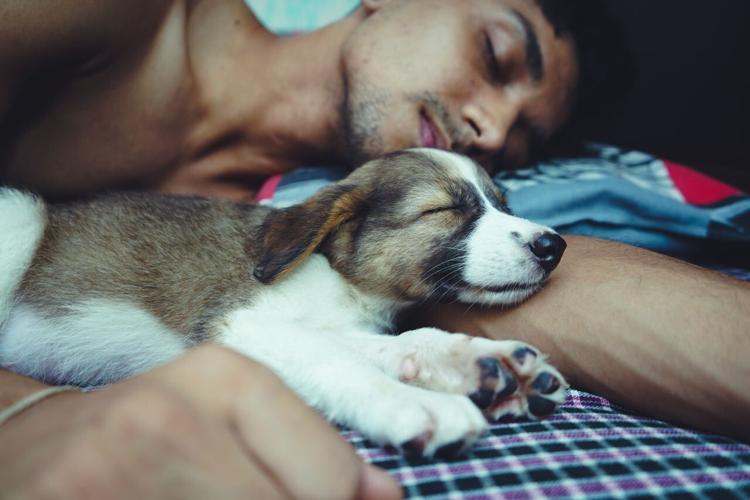




(Photo by Yogendra Singh via Pexels)
By Stephen Beech
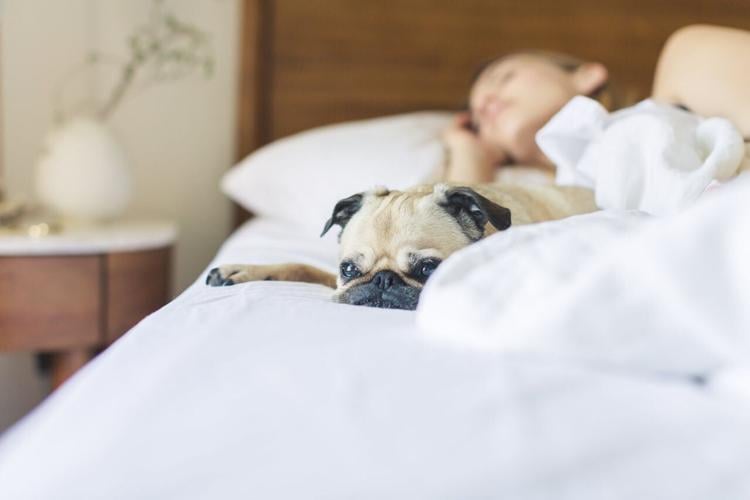
Dog owners who share a bed with their pets sleep more soundly than expected, according to new research.
The nighttime movements of humans and their dogs were "strongly correlated" — with them often waking at around the same time, according to the study.
And the findings suggest that some people may actually sleep better with their four-legged friends alongside them, while dogs' sleep is more likely to be disturbed by their human companion.
Scientists say it is intuitive to believe that humans and their dogs affect each other's sleep schedules, but few previous studies had been conducted in the field.

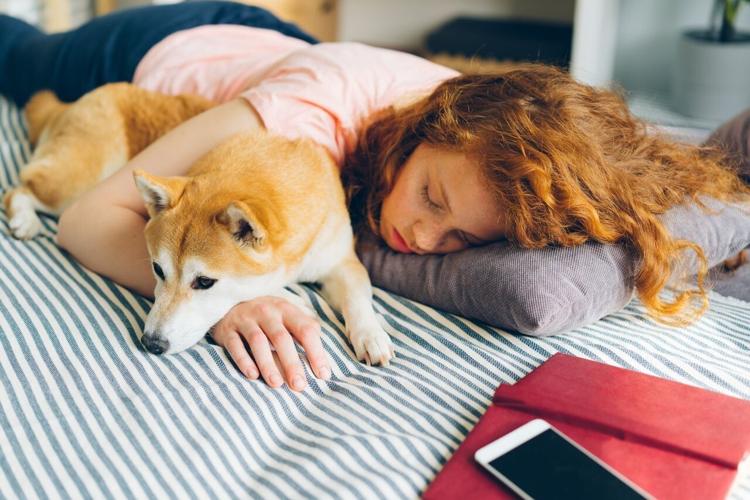
(Photo by Vitaly Gariev via Pexels)
For the new study, American and Canadian researchers examined the nighttime activity of 25 humans and their 38 dogs to investigate how they impacted each other's sleep for better or worse.
Over a period of four weeks, results from activity monitors — worn on the wrist for humans and on the collar for dogs — found that sharing the bed with a dog didn't significantly impact sleep duration or sleep quality, even in cases where owners reported feeling like their dogs were disturbing their sleep.
The findings, published in the journal PLOS One, showed that nighttime activity was "strongly correlated" — with humans and their dogs commonly becoming active around the same time in the night.
But more often than not the humans began moving before the dogs did, suggesting that owners are disturbing their dog's sleep more than the other way around.
The research team said their findings suggest that when it comes to "who is disturbing whom" it seems to be a bit of both.

(Photo by Burst via Pexels)
Study co-author Lavania Nagendran said: "Human and dog nighttime activities were generally correlated, but patterns were variable among pairs.
"Overall, their activity tended to be synchronized with human activity more often preceding dog activity than the other way around.
"Sleeping with dogs did not appear to influence objective measures of human sleep.
"However, the number of dogs in a household was associated with subjective sleep measures with people who slept with more dogs reporting poorer sleep, although this was not reflected in objective sleep measures.
"Our findings suggest that nighttime activity in humans and dogs is closely coupled and there may be discrepancies between objective and subjective sleep measures."
Co-author Ming Fei Li, Ph.D., of Duke University, North Carolina, said: "Survey data really helped strengthen the interpretation of our findings.

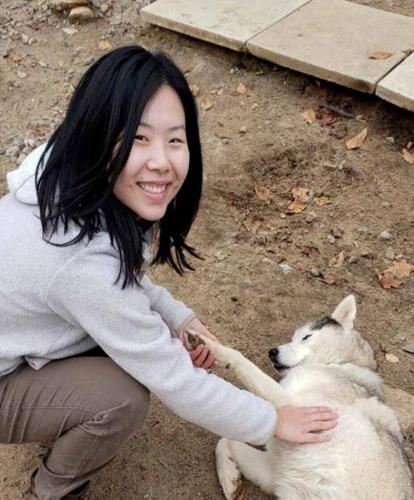
Ming Fei Li with a dog. (Ming Fei Li via SWNS)
"We found it interesting that the majority of humans reported feeling safer when sleeping with their dog, even in this relatively low-risk environment in Ontario, Canada.
"However, our time-series analysis did not necessarily point to these pet huskies being good 'watch dogs' since humans and dogs tended to synchronize their activities and in fact, it was more common for human activity to precede dog activity than the other way around.
"Nonetheless, perceived feelings of safety may contribute to the psychological benefits of living and sleeping with dogs."
Nagendran, from the University of Toronto, added: "I have a dog, and he has always slept on the bed with me.
"He is quite the cuddle bug, so I really value those moments with him.
"I've always felt that our nighttime behaviors were very synchronized; he would wake up whenever I did and vice versa.

Lavania Nagendran was one of the researchers. (Lavania Nagendran via SWNS)
"Now that he's much older, at 15, he doesn't seem to notice quite as much when I sneak out of bed.
"I think many pet owners can relate to having nighttime routines with their pets.
"For example, my dog will start to get restless and wait for me if I do not get in bed by a certain time.
"Our findings support the idea that human-companion animal relationships are two ways, with both humans and their pets influencing one another's behaviors and routines."
Li added: "We plan on comparing the activity patterns of companion dogs with other groups, such as working dogs, free-roaming dogs, and wolves, to really appreciate the diversity of context-dependent behaviors among canids, and to better understand how domestication and human influences may have contributed to these patterns."