


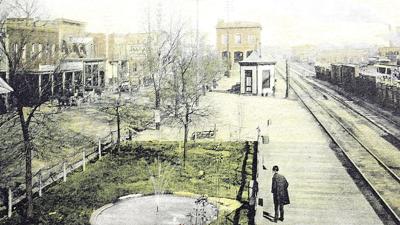
Cold, clear, gurgling water bubbling up from the ground along Main Street in De Soto gave the town its nickname, “Fountain City,” along with the city’s reputation throughout the region for quality water.
Former De Soto Library director Betty Olson said plentiful water is likely the reason the city of De Soto exists.
“Free access to water brought so many people to settle in De Soto,” Olson said. “People said it was the railroad, but the railroad didn’t come until 1859. Early settlers came because of the water. Everybody needs water, and here was water coming up out of the ground.”
The water came from artesian wells, “where the water (underground) is confined under pressure below layers of relatively impermeable rock,” according to the United States Geological Survey’s Science Water Science School website.
Depending on the amount of pressure the water is under, the wells, when tapped, can bubble up to a point just above the land’s surface or up to several dozen feet above the ground to create a gushing fountain, the website said.
Olson said she was told there were 24 artesian wells in De Soto. One well she knew about was near the intersection of Pratt and Second streets.
“When the farmers came through town, they could water their horses there,” she said.
In fact, Eddie Miller, in his book “As You Were,” which provides a history of De Soto, said its location was a convenient watering hole that was a great benefit to business.
“The largest fountain was at the intersection of Pratt and Second streets, very handy to the Lepp Flour Mill, the Hacke Wagon Works and Herman Hamel and Son’s blacksmith shop,” he wrote.
Several of the wells are near the library, Olson said.
“There was one on the lot south of the library, and during heavy rains, we had a damp place on our floor in our library,” she said. “We put in a sump pump to pump out water as it came in that took it back out to the street again.”
Bruce McKinstry, who sits on the De Soto Library’s Board of Directors, recently dealt with water in the library, after a crack appeared in the concrete floor. The water has been diverted into Joachim Creek,” he said.
There are two or three artesian wells under the library, he said.
Before the library was located there, a Save A Lot grocery store owned by the late Jack Queen stood on that spot, and before that, Thayer’s Market.
Before the grocery stores moved in, though, the water that sprang from the property was the greatest asset for a business that occupied that space – the Artesian Bottling Works.
David Williamson, a member of the De Soto Historical Society, said a man named William J. Mauthe, originally from Pacific, owned the bottling works.
He married a woman named Mary Schafer in 1886 and built a home along Main Street, according to the “Souvenir Album of De Soto: It’s People and Resources,” written in the late 1800s. Mauthe purchased the business from William Lorenz and built it up until the city became known for its water, the album said.
“He has a magnificent flowing well on his premises which he uses in many of his goods,” the album stated. “He has made the name of De Soto known wherever his several excellent brands of soda water are found.”
Miller, too, said the soda water and soft drinks made at the bottling works were a better quality than those made in “big cities.”
“Sometimes the drink would be sarsaparilla, which my dad always kept plenty of, having a case delivered each week from Mr. Mauthe’s Artesian Bottling Works in the South end of town,” he wrote.
In 1904, water from the Artesian Bottling Works was shipped to St. Louis to be served at the Louisiana Purchase Exposition (the World’s Fair).
However, McKinstry said, people in St. Louis were used to water from the muddy Mississippi, “with an acre of land in every glass,” and weren’t too fond of the clear, sweet water from De Soto.
Mauthe retired from the business in 1922 and moved to University City. He died in March of 1932.
The water from the De Soto artesian wells had other qualities, besides its clarity and convenience, that made it desirable. One was its temperature.
“The temperature varies from 56 degrees to 57 degrees Fahrenheit and that of the De Soto waterworks was 56 degrees when the air temperature was 80 degrees,” according to “Underground Waters of Missouri, Their Geology and Utilization,” published in 1907.
Williamson said other businesses also made good use of the water.
The Melba Theatre, then known as the Collins Theatre and built in 1946, had a tunnel running through the center of the theater and pumped the cool water through a pipe in the tunnel and into the radiators, and then circulated the cool air with a big fan in the summer, he said.
Williamson said the Arlington Hotel filled its pool with the water and the pump the business used for that is still there.
The fountains also made a splash along the railroad tracks in De Soto.
“There were 14 to 15 foot fountains spraying on each side of the depot,” Williamson said.
He said even his own family made use of the water bubbling up from the ground. His grandfather diverted it into a pipe and down the hill to fill a pool where cans of milk were kept cool.
Today, most of the artesian wells are capped, De Soto Public works director Kevin Warden said.
“The only one I know that is not capped is on East Main Street,” he said. “The well head is still there.”
The site is where the former People’s Dairy and Dufner’s ice cream were located.
The city of De Soto now uses water from deep wells to provide drinking water to the town, Warden said.
“I think the water has great quality,” he said.
That water comes from an aquifer, a large body of groundwater that originates in the Francois Mountains, according to the Underground Waters of Missouri.
“It is a plentiful aquifer that many cities share,” Warden said.
The well in De Soto is drilled to 1,100 feet, but the pump is now located at 400 feet.
Other than some chlorine for disinfection, the water from the well does not need to be treated, he said.
Cities that use river water for their water source must have their water treated, he said.
New LOOKING BACK features are posted regularly on the Leader website. Send ideas for a local historical feature to nvrweakly@aol.com or bring or mail it to the Leader office, 503 N. Second St. (P.O. Box 159), Festus, 63028. Please include your name, phone number and a brief description of your idea. Photos are also appreciated.