


Readers are invited to submit their historic Jefferson County photos for online publication in the Leader’s “Looking Back” online feature. Send submissions tonvrweakly@aol.comor bring or mail them to the Leader office, 503 N. Second St., Festus (P.O. Box 159, 63028). Please include your name, phone number, a brief description of what’s in the photo and how you came by it. Please also include when it was taken, where and by whom (if known). A new LOOKING BACK photo will be posted each Thursday.
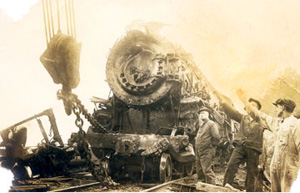
The worst railroad accident in Missouri history occurred Aug. 5, 1922, in Sulphur Springs.
That evening, the Missouri Pacific No. 4 express train slammed into the back of a smaller local train, No. 32, as the smaller train was stopped to take in water at Sulphur Springs.
A total of 34 people died and 150 were injured in the disaster.
ANew York Times storytold the tale: “Steel coaches of the express splintered the wooden coaches (of No. 32) as it plowed its way though them from the rear, dumping passengers and debris over a quarter of a mile area and tearing up the rail bed, twisting rails into a tangled mess, resembling a knotted bunch of huge ropes.”
The rear end of No. 32 was standing on the bridge over Glaize Creek when the accident occurred, and cars and people were dumped into the creek after the collision.
Residents of the area reported the crash could be heard for three miles.
Because the accident occurred at sunset, rescue efforts were hampered because of a lack of light as night fell. However, lanterns were rounded up and searchlights from a boat on the creek helped light up the area.
Despite the lack of modern conveniences, word spread quickly, and looters showed up to rob the bodies of the dead.
One man, from St. Louis, was arrested after he was found with clothes from several people as well as a Bible. Others were seen taking off with suitcases and baskets.
Dr. W.W. Hull, who lived in Sulphur Springs, was the first physician to arrive, joined by the residents of the town. Hull attended to as many as 25 people at a time before a train of doctors from De Soto arrived. A team of doctors from the Missouri Pacific Hospital in St. Louis arrived by train a short time later.
Striking shopmen from De Soto and Poplar Bluff also arrived to help rescue victims. They described the scene as “a battlefield.”
Among the 100 passengers on the local train were Boy Scouts who were going home from a summer camp in Ironton. According to reports, many of them escaped injury and some helped in rescue efforts.
The death toll could have been higher. Fortunately, several passengers of No. 32 had gotten off the train to stretch their legs while the train was stopped.
A coroner’s inquest held in Hillsboro a few days later concluded that the engineer of No. 4, a 12-car train with 180 passengers headed north from Fort Worth, Texas, had received orders while his train went through Riverside (near Pevely) to pull over on a side track at Cliff Cave in south St. Louis County to accommodate another train. While he was reading those orders, it was concluded, the engineer failed to notice a block signal along the track that No. 32 was stopped at Sulphur Springs.
That engineer, a 35-year railroad veteran who had an otherwise spotless record, jumped from his cab shortly before the crash to his death.
Patricia Lexa of Crystal City, who submitted this photo, gets credit for two LOOKING BACK entries.
She brought in this photo, which she said she got from her mother-in-law, the late Violet D. Lexa of Crystal City.
When Leader staff members removed the Sulphur Springs photo from the frame to scan it to our computer system, a photo of the Herculaneum School fire of Christmas Day 1947 was one of several other historic photos found behind it.
The fire was the subject of a last week’s LOOKING BACK.
--Steve Taylor