



From noon to 3 p.m. Monday, April 8, tune into myleaderpaper.com/eclipse to see video coverage of the total solar eclipse, streamed live from …
Get out those eclipse viewing glasses, Leader readers – it’s happening again!
Well … almost.
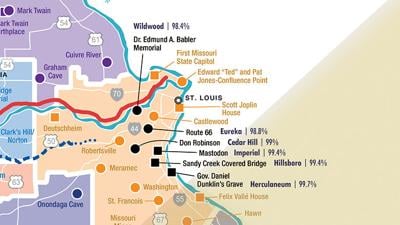
Residents in southeastern Missouri will be treated to a solar eclipse on Monday, April 8. Although Jefferson County lies outside the area that will experience totality – when the moon’s shadow completely covers the sun – it still should be a pretty spectacular view, weather permitting.
“We will get about 99 percent totality,” said Jefferson County native Don Ficken of the St. Louis Astronomical Society (SLAS). “There will still be a sliver of bright sunlight at the edge, so you can’t look directly at the sun, even during totality, without eye protection. But it will still be pretty cool.”
For specific information about the eclipse, visit the interactive map at timeanddate.com/eclipse/map/2024-april-8, zoom in on Missouri and then click on any location.
A solar eclipse occurs when the moon passes between the Earth and the sun, casting a shadow on our planet that moves from west to east. Anyone inside the path of totality will see the sun slowly blocked out until all that remains visible is the corona, or bright outer atmosphere, and the sun will remain obscured for a time before gradually coming back into view.
The county was in the path of totality for the August 2017 total solar eclipse, enjoying more than two minutes of eerie, daytime darkness. During that time, some strange natural phenomena took place. Although the sky was dark, it was lighter all around the horizon, almost like a 360-degree sunrise. The temperature dropped noticeably, dusk-to-dawn lights came on, birds began coming to roost and insects and peeper frogs began to voice their usually nocturnal songs.
This time around, the eclipse will start around 12:30 p.m. and end about 3:15 p.m., with totality beginning at about 1:50 p.m.
Ficken said people are more aware now of what an eclipse means.
“It’s a much different educational process than before 2017,” he said. “It had been more than 500 years since we had one (a total solar eclipse) here, but now it’s been just seven years. People know about it. But it’s going to be even more spectacular this time.”
He said, although the eclipse will be something special here, it is best experienced inside the path of totality.
“Go to totality if you can,” he said. “Ninety-nine percent is great but it’s not total. It’s like going to the big game and being in the parking lot and not the stadium.”
Bigger, better, longer
What will make this year’s eclipse a more intense experience than the last one?
■ The moon is closer to the earth this year than it was in 2017, so the shadow it casts as it passes in front of the sun will be larger. The path ranged from 62-71 miles wide in 2017; the upcoming eclipse path will range between 108-122 miles across.
This year’s path also will pass over more cities and populated areas than the 2017 eclipse. Back then, about 12 million people lived in the path of totality; this year it is estimated the path will pass over about 31 million people, with another 150 million within 200 miles on either side.
Residents in all 50 U.S. states will experience some degree of partial solar eclipse.
■ The period of totality will be almost twice as long. In 2017, the longest period of totality was 2 minutes, 42 seconds near Carbondale, Ill. This year, totality will last more than 4 minutes over a large stretch of the eclipse path, including much of southeastern Missouri. Totality lasts longest at the center of the path, falling off toward the edges.
“And it will be darker,” Ficken said. “Because the path (of totality) is wider, the light at the horizon is further away.”
He also said during totality, there will be planets, stars and even a comet visible that ordinarily are impossible to see.
■ The sun is undergoing a period of heightened electromagnetic activity. Every 11 years or so, the sun’s magnetic field flips, causing a cycle of varying solar activity. The 2017 eclipse took place when the sun was nearing minimum activity, while this year’s event will take place during a period of near-maximum activity. Those viewing the eclipse on April 8 may get to see solar flares, solar prominences – bright pink curls or loops coming off the sun – and even a coronal mass ejection, when a large amount of material erupts from the sun’s surface.
■ Scientific research is expanded for the 2024 eclipse. NASA is funding several research initiatives to study the eclipse phenomenon with a variety of instruments, including cameras aboard high-altitude research planes. Instruments will be launched from rockets to make observations from outside the atmosphere. And NASA and ESA (the European Space Agency) have collaborated on a solar orbiter that will provide information from the sun’s corona itself.
To learn more about the topic, visit science/nasa.gov.
Not just with the eyes
Ficken urges those who plan to view the eclipse to concentrate on more than just one sense.
“I would suggest people try to think about using all their senses this time,” he said. “I’m doing a project to capture sounds during the eclipse. Pay attention to temperature changes as well. Did the temperature drop? Did the clouds change? These are things that bring all the senses into play.”
Those who do watch absolutely must have eye protection. (See sidebar below this story.)
Local libraries have scheduled a few events and watch parties; see individual library websites for up-to-date information.
Ficken said some local schools are planning to allow students to view the eclipse, but there are logistical problems.
“It is complicated by the fact that totality will take place around 2 o’clock,” he said. “That’s right when they’re getting the kids ready to go home. Some of the schools down south are just giving students the day off.”
Ficken said we are all incredibly lucky to have experienced two total solar eclipse events in such a short time.
“We’re very spoiled,” he said. “Don’t think because we had one in 2017, then again in 2024, that they’re going to be common. We will have one in 2178, but it will be partial here.
“The next time a total solar eclipse will be visible from the St. Louis area will be in 2505.”
For more information about the April 8 eclipse, here are a few helpful websites: