


It all started with near-roadkill. My wife and I recently were tooling up a street in downtown Festus in our Ford Escape, me behind the wheel, when a squirrel dashed in front of us. I didn’t slow down because I couldn’t react fast enough. The little critter somehow passed underneath and safely reached the other side.
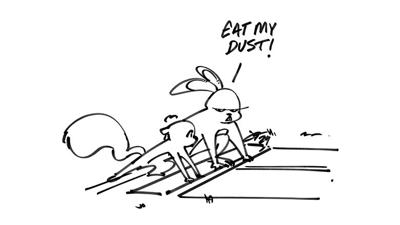
At that moment I wondered (don’t ask why), which is faster, squirrels or rabbits?
Peggy, who is superglued to her iPad every moment when I’m driving us, quickly Googled the answer. Rabbits can run as fast as 40 mph while squirrels top out at about 12.
She called up that answer in less than 20 seconds (source: the New York Times). So then my crazy mind conjured another question: How long would it have taken to look that up in an encyclopedia?
A lot longer. I visited our downstairs library and hauled out Volume 16 (Q-R) of our 1984 World Book set and it informed me that rabbits, when frightened, can jump 10 feet and run up to 18 mph. The listing for squirrels, in Vol. 18 (So-Sz), gave no information on speed.
World Book is no match for Google and its powerful sidekick, Wikipedia, whose name literally means “quick knowledge.” Thus you would think ponderous print encyclopedias like World Book are long gone.
And you would be wrong. World Book 2024, all 22 volumes and 14,000 pages, is available now for a mere $1,199. It bills itself as “The only general reference encyclopedia still published today.” Its biggest competitor, Encyclopedia Britannica – founded in Scotland in 1768 – stopped print publication in 2010 and is online-only.
Although my parents bought another big encyclopedia set called The Book of Knowledge before I was in grade school, I always preferred World Book because it was fun and easy to page-surf over random topics. I just did that in writing this column. While flipping through to “Rabbits” I read an entry on the controversial novelist Ayn Rand (1905-1982) – an icon of conservative social/political ideology in the 1950s and 1960s – which noted, “Most critics do not consider (her novels) works of literary excellence.” Hmph.
Shortly before I graduated from the Mizzou School of Journalism in 1977, I flew up to Chicago for a job interview at World Book, as an editor. It was my first plane ride, on Ozark Airlines (now that’s dating myself). The job paid peanuts (less than $150 per week), and I wasn’t crazy about taking a small desk in a large room full of faceless editors, so I turned it down.
But I still liked the product and we bought the complete set when our older son, Peter, was only 3 and younger son, Philip, was on the way. All three of our kids (including Joanna, born 1987) used the set in their schoolwork, so it was worth the $1,000 investment.
Our squirrels vs. rabbits inquiry led to another discussion about items still around today that appear to be on the way out.
■ Alarm clocks
■ AM on car radios
■ Business cards
■ Cash
■ Chalkboards
■ Charging cables
■ Checkbooks
■ Compact disks (CDs)
■ Desktop computers
■ Digital video disks (DVDs)
■ Fax machines
■ Film cameras
■ Keys (house and car)
■ Manual car transmissions
■ Movie theaters
■ Paper anything (bills, tickets, receipts, statements)
■ Phone books
■ Print magazines
■ Remote controls
■ Road atlases
■ Telephone landlines
■ Textbooks for school
I could go on. The main thing to remember is that obsolescence is unpredictable. Some everyday items disappear and others defy the odds. Television was supposed to make radio obsolete. That didn’t happen. The same fate was predicted for motion pictures. After more than a century, we’re still enjoying them.
We’re also seeing once-familiar stuff fade out and then come roaring back as classic “retro-chic.” The best example I can think of is vinyl LP records. We had boxes full of them years ago, the big albums from John Denver, the Moody Blues, Elton John, the Doobie Brothers and many more – and I sold them for next to nothing to the Vintage Vinyl store up in University City.
That was foolish in more than one way. The Elton John LP was a treasured gift from my brother-in-law to my wife. Oops. At least I got 7 cents.
Even without a turntable to play them on, I should have figured LPs would retain real value as cultural touchstones. True collectors can’t afford to be casual.
I believe the pivot point on all things technological and cultural is coming down to my generation, the baby boomers. We are single-handedly responsible for the extended lives of many of the not-obsolete-but-should-be items.
And you, dear readers, boomers or otherwise, probably noticed the one big item I left off the list: Print newspapers. The conventional wisdom is they’re going, going, nearly gone. Our recent Support Local Journalism campaign proves otherwise. We are still in awe of your overwhelming expressions of encouragement and financial support.
Thankfully, community never goes obsolete.