



Most of us are aware of the phrase, “With great power comes great responsibility.”
The quote, most associated with Uncle Ben from Spider-Man, has been a driving force for Marvel’s flagship superhero since it was first printed in Amazing Fantasy No. 15 in 1962. Back then, of course, the phrase wasn’t spoken, but instead appeared in a voiceless text box that read, “And a lean, silent figure slowly fades into the gathering darkness, aware at last that in this world, with great power there must also come – great responsibility!”
If the first 89 words of this column hasn’t tipped you off, I am the coworker Kevin Carbery referred to in his recent trivia column about superheroes.
And as the newsroom’s resident comic book nerd, I take my position seriously and feel I must resurrect the debates I had during my youth in comic book stores and conventions and now have them at the Leader’s worldwide headquarters.
One of my favorite debates has always been the mislabeling of superheroes.
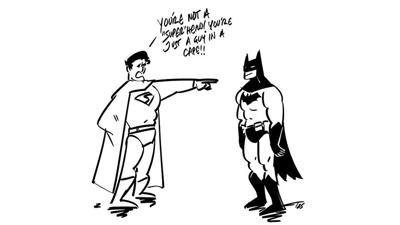
I am firmly in the camp that believes a superhero must have some form of “superpower” that you or I cannot hone through dedication, hard work, time and an endless supply of resources. Hence, my objection to classifying Batman or Iron Man as superheroes.
These characters are heroes, and iconic ones, but they are not superheroes, although Iron Man was one of the most boring characters before being reshaped in the Marvel Cinematic Universe by Robert Downey Jr.’s excellent portrayal of the tech-genius billionaire.
At the end of the day, any of us could become Iron Man, with just a little luck and the financial capital, technological aptitude and complete disregard for physics that is available in the world of comic book characters. The same can be said for becoming Batman. The two characters are really just dudes in suits with fancy gadgets.
So, nope, Batman and Iron Man are not superheroes, they are heroes.
Superheroes are characters like the aforementioned Spider-Man. They have special powers.
Peter Parker, for example, gained his extraordinary powers through a radioactive spider bite that enhanced his reflexes and agility, gave him elevated strength and an extra sense to detect danger.
Superman, typically credited as the creation that introduced the superhero age of comic books, would be a normal guy if not for the Earth’s yellow sun. He became a superhero because his biology changed from exposure to yellow sun rays versus red sun rays. The yellow sun made him invulnerable, enhanced his strength to near unmeasured levels, gave him heat vision and arctic breath and the gift of flight.
He has innate abilities that can’t be taken away, depending on his portrayal and if the mythos of kryptonite is still perceived as a way to rob him of his powers. There are plenty of portrayals of Superman not having a kryptonite vulnerability because of his prolonged exposure to the yellow sun, and there are times when he is overly susceptible to magic.
But I digress.
This argument can be expanded to Thor or the Martian Manhunter, who are not superheroes. Heck, one might even say they are not heroes, at all, but instead just beings with astonishing powers who typically act heroically.
Thor is a Norse god. He appears to be a superhero on Earth, or Midgard, because he is not in his home realm of Asgard. Everyone in Asgard has some variation of Thor’s power and ability. Even his half-brother, Loki, is an accomplished trickster who can construct something out of nothing.
The Martian Manhunter, or J’onn J’onzz or John Jones, is an alien from Mars. The same argument against Thor being a superhero applies here. The Martian Manhunter has abilities that are not human, but on Mars, he would just be a regular dude who can fly, lift very heavy things, somehow have heat vision while being vulnerable to fire and morph his shape into something else.
So back to characters that are superheroes.
The Flash, in all incarnations, though most famously as Barry Allen, is a superhero. While he initially gained his power from a freak chemical accident when lightning struck, the Flash and multiple versions and incarnations taps into the “Speed Force” to move faster than nearly all other beings in the fantasy land that is the DC universe.
Back to the Marvel side of things, nearly all members of the X-Men are superheroes.
The X-Men are mutants born with special abilities that are an evolutionary step above humans.
There is Wolverine, who is probably the most well-known from my favorite comic book series. He has an accelerated healing power that allows him to shrug off most wounds and makes him nearly immortal. The whole “adamantium” skeleton and claws came later, and his extraordinary healing power is the only reason that fictitious metal could be fused to him.
As the old adage in basketball goes, “You can’t teach height.” Well, you can’t teach “healing power.”
While there may be folks out there, and here at Leader worldwide headquarters, who dispute my stance of hero versus superhero, I stand by this argument.
If it can’t be taught or trained, then it is a power and that makes a character super.
If theoretically a character’s “power” can be learned or built, that is a hero.