
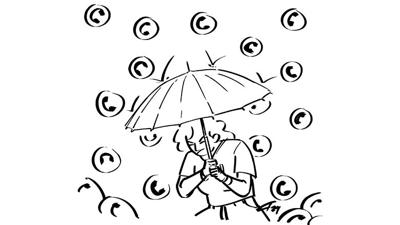

One number pops up on my caller ID more than any other. Nope, it’s not my husband’s number. It’s not my sister’s or best friend’s either. It’s not even politicians looking for donations.
I get calls from this number even more often than from the Red Cross, if you can believe it, and it’s a name you’re probably all too familiar with, too: “Spam Likely.”
Earlier this year, Federal Communications Commission (FCC) Commissioner Geoffrey Starks called unwanted robocalls “a scourge on our society.” That’s putting it mildly, in my opinion.
Even these days, when we seem to be so divided, hatred of spam calls is probably one subject we can all agree on. They’re an absolute nuisance.
The number one complaint the FCC receives is about robocalls, making up more than 60 percent of the agency’s complaints, adding up to more than 200,000 per year. The FCC said that spam calls make up more than half of all incoming calls the average person receives in the U.S. I’m sure my average is far higher than that.
I’m constantly receiving calls from people pretending to be from the IRS, Health Insurance Marketplace, Social Security Administration or U.S. Customs and Border Protection. I’ve received calls from people claiming to be student loan collectors or medical device providers, as well as from some offering to help me with debt consolidation or wanting to sell me an auto warranty.
Sometimes the number of calls I receive will slow down, only to mysteriously ramp back up to a furious pace after a few weeks. I recently received two spam calls at the same time.
I know, I know, people say, “Just don’t answer any calls from people who aren’t on your contact list,” but as a reporter, that’s difficult. My job regularly requires me to make and receive phone calls from people I’ve never spoken to before. Not only do many of the people I’m trying to call for an interview let the call go to voicemail thinking I’m a spam caller, but often I mistakenly pick up spam calls thinking it’s someone calling me back.
It can be hard to tell what’s a legitimate call when so many calls I receive are spoofing calls, which means the caller alters the number that appears on your caller ID to hide their identity. Those callers often use a local number that people are more likely to answer.
Many of the calls I receive are labeled as “Spam Likely,” but quite a few are not, leaving me to wonder if I should answer the call and risk encouraging scammers, or ignore the call and possibly miss out on vital information from a news source.
So when I’m expecting calls from Jefferson County residents for stories I’m working on, it’s hard not to pick up calls that start with 636, 573 or 314. The problem with that is for every call you answer from a scammer, it seems to cause five more to follow.
According to TrueCaller, a caller ID and spam-blocking app, people lost a total of almost $40 billion to scams and spam in the US in 2022. According to a survey by Hiya, a company that provides call-protection and identity services, the average amount of money lost by people scammed in the US that same year was $431.26.
TrueCaller ranks Missouri as the 10th highest state in the country for the most unwanted calls on average per user per month.
What can be done about this problem? People receive these calls despite being on the Do Not Call list – a list that only applies to sales calls. Being on the DNC does nothing to block incoming calls. And those who are calling illegally to scam you certainly don’t care whether you’re on that list or not.
Experts say not to pick up robocalls because that lets scammers know you have a live number, which will just result in more calls.
But I think putting the onus on consumers to stop spam calls is looking at the wrong end of the problem. I don’t think it should be up to individuals to fight against spam calls. It should be up to the FCC to fix this problem since it has the authority and power to make changes to protect consumers.
FCC Chairwoman Jessica Rosenworcel is quoted on the FCC website as saying, “We’re not going to stop until we get robocallers, spoofers, and scammers off the line.”
The FCC website also says the agency is cracking down on illegal calls in a variety of ways: issuing hundreds of millions of dollars in enforcement actions against illegal robocallers; empowering phone companies to block illegal or unwanted calls based on reasonable call analytics; allowing consumer options on tools to block calls from any number that doesn’t appear on a customer’s contact list or other “white list” and requiring phone companies to implement caller ID authentication to help reduce illegal spoofing.
But the FCC has been claiming for years that it is “cracking down” on spam calls, and so far, if any of the steps they have taken have made a dent in the volume of spam calls, I’m certainly not seeing the results.
I believe the FCC can do far more. Fines could be higher, requirements for phone companies more stringent. There has to be more that can be done to verify the location of outbound calls to ensure numbers are not being spoofed.
From its inception, the FCC has been charged by Congress with a broad mandate to regulate the country’s communications networks according to “the public interest.” Certainly a problem that has been the public’s number one complaint year after year is the definition of public interest.