


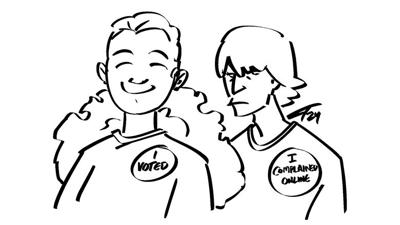

I see it all the time.
A city council, a school board or the County Council has made a decision and people are mad. Comments on social media comments are full of anger, vitriol and finger-pointing about how this decision could have possibly been made.
“Why didn’t they do that?” (Insert some idea, often a wacky, illegal or wildly impractical option.)
Then the accusations start.
“They’re all corrupt!”
“I wonder how much money they got paid to do that!”
“It’s because they’re buddies with so-and-so.”
And then the biggest complaint: “Why didn’t I get a vote on that? When do I get my say?”
Well, I hate to break it to you, but you did get your say.
When your city council member or school board member has run unopposed for the last three elections, and you didn’t care to run or volunteer or donate to anyone else’s campaign, your non-participation said, “I agree with whatever the incumbent chooses to do.”
A person on an elected board recently told me that because their board hadn’t had any contested races for years, it was a sign to them that people were very happy with what they were doing. Although it’s a sad sentiment, it’s hard to argue with the logic.
These members typically get paid very little, usually a couple of hundred dollars a month, if anything at all. It’s certainly not enough to be considered a money-making venture, especially given the time commitment a lot of them assume.
I understand that running for a board isn’t for everyone. Many people can’t make the time commitment; others have too much anxiety being in the public eye.
Luckily, there are other ways to make your voice heard, such as voting.
When it was time for school board elections, city council elections, mayoral elections, county council elections, and you didn’t show up to vote (participation in the April 2024 election was a measly 9.7 percent in Jefferson County), your decision to stay at home said, “I don’t care who represents me or what they do.”
Another way to participate is by attending meetings. All these publicly elected boards are required to post their agendas, and most do so online. I’ve never had trouble finding any of those agendas, and as part of my job, that’s something I do quite often. For big decisions, changes usually do not happen over one meeting. There’s a step-by-step process that occurs over the course of several meetings, if not months.
These boards are not “hiding” anything from the public simply because the public chooses not to look.
I have gone to many of these types of meetings in my role as a reporter, and for almost every meeting, there are usually fewer than three residents in attendance in a town of thousands. At plenty of meetings, I was the only person in the audience.
When you don’t attend the meetings, your non-attendance says, “I don’t care what is decided in these meetings.”
I get it. Those meetings are typically very dry and boring. A lot of times not much seems to happen. However, they are a great opportunity to make your voice heard.
Most public bodies provide opportunities for public comments, if you want to let them know your thoughts. Your city’s website most likely has your council person’s phone number and email address readily available. When you didn’t make a public comment about a concern and didn’t contact your council person or school board member about a topic of interest, your silence said, “I have no concerns and agree with whatever you choose to do.”
Another way to participate is simply by staying informed. When big changes are coming, typically the Leader runs stories about them. Do you read those stories to find out what’s coming up, or do you skip them because it’s not something that interests you? Online, we can see which stories readers are clicking on to read. I haven’t seen many weeks where reporting on the actions of a board or council have taken up any of the most popular slots. Such stories typically don’t even crack the top 10.
Another avenue to make your voice heard is in the paper itself. The Leader allows readers to submit letters to the editor to share their opinions on various topics. I can’t tell you how delighted I’d be to see letters coming in on a topic other than Trump vs. Biden or whatever national controversy has people riled up this week. But sadly, the number of letters we get on local topics is low.
There are so many opportunities for residents to make their voices heard, and for the vast majority of people, they are choosing not to do so, until either the very last meeting before the final vote, or after the ink has dried and it’s all said and done. Suddenly they are very interested and are outraged that they haven’t been personally asked for their opinion.
I don’t know if they expect every issue to come up for a public vote instead of being handled by their board or council. If that was the case, there wouldn’t be much need for a board or council. We’d just publicly vote on every topic. But given the abysmal voter turnout on the elections we do have, I can’t imagine turnout would be any better if voting on issues large and small took place every month.
There are mechanisms for the public to make their voices heard. But making angry comments after the fact on a city’s or school district’s or local newspaper’s Facebook page isn’t a particularly effective one.
I’ve been somewhat interested in being a poll worker for a couple of years now. I mean, who wouldn’t jump at the chance to work a 14-plus-hour day for a whopping $125? I sent in the paperwork to become a poll worker just a few weeks ago, and when I tell you that I got a call almost immediately, I am not joking. I guess volunteering to be a poll worker is even less popular than voting itself.
I was asked to work on the recent April 2 election.
Let me tell you what I learned between 6 a.m. and 7 p.m. that day: Most people do not care. Of the registered voters who did show up, I would guess that probably at least 80 percent of those voters were over age 65.
If as many people showed up to the polls as complain about the results of the elections on social media, they might actually get what they want. Just food for thought.