


More and more, people are using artificial intelligence (AI), especially in their social media feeds. While the advancement of AI over the last few years has been amazing, it has made it increasingly difficult for people to know if the content they’re viewing is real.
As a journalist, I feel it is my duty to make sure people know what news they are consuming, especially if the content may not be real.
Since I’m chronically in touch with internet culture, it is usually pretty easy for me to tell if an image or video is real. But I will admit it does stump me sometimes.
Now that we’re living in the AI world, it’s important to double, and even triple, check the sources for the content we’re viewing so misinformation does not continuously get spread. The danger of sharing fake AI images or videos heavily depends on the content.
For example, if you are sending your relatives an AI-generated image of a cute cat, it is generally harmless. However, if you share an AI image of a public official or celebrity committing a heinous act, it could have a different, and potentially negative, effect, especially if the person sharing the image doesn’t acknowledge that the image is not real.
With AI continuously evolving, it has become increasingly difficult to distinguish what content is real and what is not.
What is AI?
According to NASA, AI refers to “computer systems that can perform complex tasks normally done by human-reasoning, decision-making, creating, etc.” Therefore, when you refer to AI-generated content, like pictures, videos or audio, they are all created by these computer systems.
While AI has only recently begun making headlines, the first concepts of AI were imagined in the 18th century. Those first thoughts about AI related to figuring out the probability of events and solving systems of equations. In the late 19th century and early 20th century, the field of modern statistics emerged, later maturing into the construction of the first electronic computers.
AI was first officially workshopped and organized in the mid-1950s by John McCarthy attending the Dartmouth Summer Research Project on Artificial Intelligence. McCarthy was an American computer scientist who first used the term “artificial intelligence” in a proposal he co-authored in the workshop. Between the 1950s and 1970s, we saw more advancements in computers and robotics, further moving along the development of AI.
Nowadays, everyone who has a computer has access to AI. In addition, Chat GPT, Google Gemini and many other programs have free-to-use AI- generating tools that allow people to use them to describe images, answer questions or even have a “conversation” with AI.
Ways to detect AI
A good rule of thumb to follow when questioning if something is AI-generated is to ask yourself, “Is this too good to be true?” If you’re asking that question, chances are it’s not true.
Other than intuitive thinking, there are some ways to inspect a photo for AI qualities.
One way is to look at the subjects of the photo. Often, people can tell if a photo is AI if it has a too smooth or airbrushed look, whether it’s a realistic picture or a cartoon.
Another common way to determine if an image is AI-generated is to look for unnatural features. Check the hands and limbs of the subjects in the picture or video. Sometimes, the subjects may have extra fingers or distorted limbs.
Examples
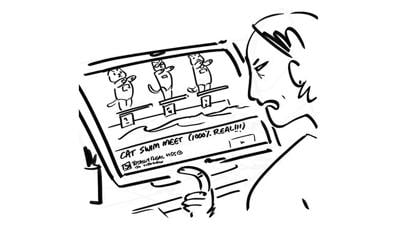
Recently I came across videos of cats jumping off a diving board at what was supposedly an Olympic event. At first, the cats on the diving board move naturally, like an actual cat would. But then, the cats prepare to jump off the diving board and begin to look a little disfigured, especially when they jump from the board into the water. I noticed another clue that the video was AI-generated in the background of the video, where wording in the arena looked like gibberish. Some signs featured words like “Lonkon 2012” or “LaununAvep.” Some of the words in the background even changed between the camera movements.
Besides closely inspecting content, another way to tell if it’s AI-generated is to look at the description. For example, the cat video said the cats were competing. Sometimes captions clearly state if a video is AI, but it isn’t always that easy to know.
I’ve also seen a photo of a little girl and her puppy in a boat who supposedly were being rescued during Hurricane Helene. At first, it looked like it could be real. But on closer inspection, you realized that the image looks airbrushed and the boat is filled with water, not to mention that the girl and puppy are alone in the boat, all good indicators that the image was AI-generated.
According to Houston-based Click 2 news reports from October 2024, one person said she felt manipulated by that photo, which was circulating on social media. The motivation behind the image most likely was to gain more clicks, but it ultimately sparked an emotional outpouring from people sympathizing with the little girl. Images like this can cause problems for real journalists and news outlets who might be asked to explain why they weren’t covering that particular news story.
If, after carefully reviewing content, it’s still unclear whether it’s real or AI-generated, a simple internet search may lead to the answer. However, caution is needed when using a Google search since the popular search engine introduced “AI Overview” in May 2024. When AI Overview pops up, it summarizes facts from different sources, but those AI responses are not always credible. In fact, there is a disclaimer on those summaries that says, “AI responses may include mistakes.”
I believe AI can be an incredible tool, but it should be used and viewed with caution.