



You know how when company’s coming, you rush through your house to pick things up, stack things into piles, push things under other things and dust off all that newly exposed grime?
The hope is your visitors will believe you live like that – in a well-ordered, good-looking, good-smelling space. (Air freshener can usually take care of last night’s sauteed onions, but the cat box is a higher hill. You might have to clean it.)
The first place my husband, Gordon, heads in these circumstances is to the table in the breakfast nook, where he sweeps his astonishing lineup of medications into a tote bag for banishment to the bedroom.
After everyone leaves, it comes out again – more vials and bottles than a preschooler can comfortably count, all aimed at giving him more quality, and, most importantly, quantity, of life.
Who knew it would come to this?
This was a guy who had to be ardently persuaded to take ibuprofen – just one – when under the weather.
But it all changed more than two years ago, when a life-threatening attack of heart arrythmia led to a diagnosis, a pacemaker and an array of medication. Now, he takes pills – lots.
That was the first shoe to drop in our changed lives. The second dropped when we realized how many trips we’d now have to make to the pharmacy – lots. After all, he wasn’t the only one in the house who pretty suddenly had the drug store on speed dial.
And then a third shoe fell to the floor. (I know most of us don’t typically wear three at a time, but a spare can come in handy, especially when registering shock.)
We unfortunately learned there was a hefty sticker price to all this (unh, unh, unh, unh) Stayin’ Alive.
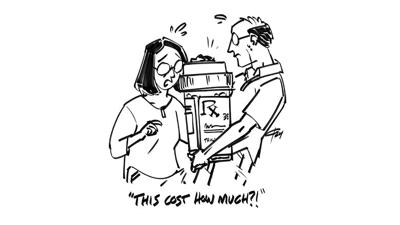
Two of Gordon’s life-preserving medications tallied to hundreds of extra dollars every month, despite enrollment in Medicare Part D (the program’s prescription drug coverage option) and a good supplemental insurance plan.
Not to mention the time we bought a $500 three-month supply of medication the week before his cardiologist replaced that drug with something else (no, you do not get your money back). Or, when I accidentally was prescribed two inhalers to combat Covid, rather than one. Chalk up another unnecessary $500, because once you carry away a prescription from the pharmacist’s window, it’s yours.
Sure, I’d heard over the years about people on fixed incomes who were facing a “donut hole” in insurance coverage for their medication. But I didn’t pay much attention until these concepts hit me squarely in my own donut. Oooomph!
I checked when Gordon’s expensive drugs would go generic and learned it was on the horizon, but distant enough we’d probably cease caring first.
And, actually, our insurance was covering the lion’s share of the cost, so I could be grateful for that. If, that is, the drugs’ starting price had been even slightly affordable.
Then came passage of the Inflation Reduction Act in August 2022, a climate, health and tax bill that cleared the U.S. House by only seven votes and required a tie-breaking vote by Vice President Kamala Harris to pass the Senate. No Republicans voted for it in either body.
The law has a lot in it, and many parts are red/blue controversial. For starters, almost everyone agrees it has little to no impact on inflation.
But a portion of the legislation offers relief to seniors who are currently paying a boatload of money for prescriptions. Obviously, I like this – lots.
The law allows Medicare to negotiate the prices on 10 of the most expensive brand-name drugs, with recently announced much-lower sticker prices taking effect in 2026. Gordon’s two budget-busters are on the list, and more drugs will become eligible for negotiation in subsequent years.
Also, starting in 2025, people who are enrolled in Medicare Part D will have a $2,000 annual cap on their drug expenses (and this includes their deductible, co-pays and co-insurance costs).
This is expected to save about 20 million seniors at least $400 annually, with 2 million of those saving an average of $2,500 a year.
We will be among the savers.
I’m not dancing in the streets yet, because there are threats to this lifeline.
Predictably, drug makers are suing, although unsuccessfully, so far. Expect this to be in the courts for years to come, with the possibility of Supreme Court intervention.
Also, something that passed Congress with such a narrow margin could be subject to recall in future power shifts. Some current officials have promised to pull back the whole shebang.
But perhaps the biggest danger is a lack of knowledge among the senior community.
In a survey conducted four months ago, only about half of people 65 and older knew about the drug price negotiation program.
That number might be higher now, after the announcement of the negotiation results. Hope so. Because seniors need to be heard on why this assistance matters and must be preserved.
For folks under 65, don’t discount your need to keep apprised and to weigh in, as well.
Back in the day, I was wearing your shoes, and one day you’ll be wearing mine.