

I’ve always deeply resonated with the story of immigrants coming to America.
The intrepid voyager, giving up everything they’ve ever known to strike out in search of a better life.
Most likely, a person who is willing to make such a gamble has very little to lose and much to gain. It stands to reason that a many of our own immigrant ancestors had little more than a few pennies to rub together and the clothes on their backs after paying for passage to this great country.
That was the story I was told about my father’s grandmother, Goldie Briggs, who I am named after. My dad always told me and my sisters that Goldie had boarded a ship from Ireland during the Irish Potato Famine to keep from starving, arrived in America and found herself a German immigrant husband and had a family of 13 children. My dad told us they both had thick accents from their homelands.
So, after graduating from college, I decided to visit Ireland myself to see the land of my roots. As a redhead with green eyes and freckles, it was particularly exciting to think of a land filled with people that looked just like me. And to my delight, while exploring Dublin, I was constantly stopped by tourists asking for directions because they thought I was a native.
I am home, I thought.
My trip to Ireland coincided with the 2010 South Africa World Cup, and I was completely taken aback by how utterly obsessed everyone was with soccer. It was on every TV in every bar and café. People were wearing jerseys and displaying flags everywhere, all the time. It’s all anyone talked about.
I, on the other hand, knew nothing of soccer.
While trying to make polite conversation at a pub with an Irishman, I made what I can clearly see now was a very American faux pas.
“Wow, you guys are like really into soccer here, huh?”
The person I was chatting with looked at me as if I’d grown a second head. I might as well have said, “You guys seem pretty keen on breathing air.”
“First of all, it’s not soccer, it’s football. And second of all, it’s the most popular sport in the entire world, so yes, I’d say we’re pretty into it.”
I irritated him further, inquiring how long each quarter was. (Apparently, it’s played in halves, not quarters. Who knew?) And I asked how being offsides in soccer was different than being offsides in American football (Don’t ask me, I still don’t understand it.).
While I never figured out the rules of football, I started to get into the spirit of the international event.
All summer, the bee-like buzzing sounds of vuvuzelas, a plastic horn from South Africa, could be heard on every street corner. I watched several games at pubs in the tourist district and watched German and Spanish tourists nearly come to blows during a crucial Spain versus Germany game to determine who would go to the finals. Spain won 1-0 and moved on to the first-place match while Germany would compete for third.
Days after their intense rivalry, I saw those same German tourists who had been in tears at the loss against Spain cheering loudly with their Spanish counterparts as Spain defeated the Netherlands 1-0. Every single person in the pub joined the Spanish tourists screaming “Yo soy Español,” over and over while hugging and thumping each other on the backs.
Me, barely having understood a fraction of the game, “Yo soy Español-ed” with the best of them, tears streaming down my own face. For a few minutes, it really felt like we were all Spanish as we all shared in their national pride.
I’ve had that same overwhelming feeling of pride this summer while the Americas hosted the World Cup, but it has had nothing to do with the games.
I swelled with pride reading about the people of Lawrence, Kan., making team Algeria feel welcome by wearing their jerseys and singing and playing their national anthem. I welled up with tears watching the videos of our own Bosnian immigrants in St. Louis welcoming the Bosnia and Herzegovina team to town and filling the stadium with blue and yellow.
I loved seeing Norwegian fans gather in masse in Times Square to do their “Viking Row” chant. I laughed out loud, watching the Scottish fans take over the city of Boston while drinking the town dry and how well they were received by the locals who were glad for their rowdy visitors.
I’ve loved watching our foreign guests talk about the amazing American food they’ve eaten, our land’s natural beauty, our gas stations and wholesale stores and even our tumultuous weather.
But what I’ve been most proud of has been their descriptions of Americans themselves.
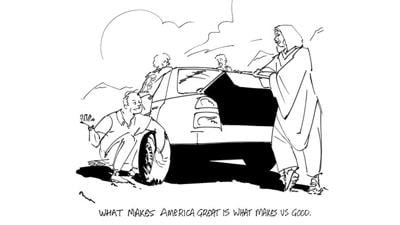
To me, one of the biggest compliments I hear about the American people is as individuals, we are genuinely kind, even when we don’t have to be. We stop to help someone change a tire. We help a stranger lift something heavy when we see them struggling. We take the time to give someone lost directions. We give recommendations to travelers. We are generous with our energy, our time and especially with our food. These are American values.
National pride doesn’t come from our government or political parties. It doesn’t come from the number of flags we display or wear on our T-shirts and hats. What makes America great is what makes the American people good. It’s how we choose to treat others. To welcome the stranger, to feed the hungry, to comfort the sick and protect the vulnerable.
Honestly, the melting pot of the world hosting the World Cup felt like one big happy long-lost family reunion. The feel-good vibes had many of us asking, “Can our cousins visit again next summer?”
As an aside, I got really into genealogy last summer. As I was putting together my family tree, I quickly realized that my father’s story about Goldie made zero sense. The Irish Potato Famine started in the mid-1840s. Goldie died in 1967. So, unless she lived to be about 140 years old, the math did not check out.
So, I looked it up. The entire story was a complete fabrication.
My “Irish” great-grandmother was born in Illinois. Her parents were born in Illinois. Her grandparents were born in Illinois. In fact, her family went back 10 generations (13 for me) to before the United States was even a country. Her first American-born ancestor was in Bristol, Mass., in 1629.
Not only was my “Irish immigrant” ancestor not a recent transplant, but she also wasn’t even Irish. Her family was from England and changed their name from “Bridge” to Briggs on arrival in the new world. That entire side of my family tree is almost completely English.
Well, that just about broke my poor little Irish heart.