
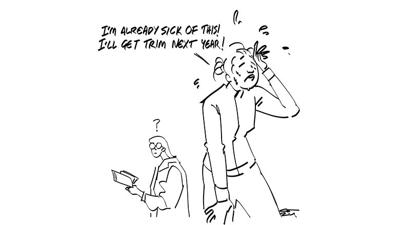
New year, new you? Not me.
Many people use the new year to “reset” – to rediscover the activities they love and start healthier habits.
Unless some external force demands a deadline, I’m probably not going to do it any time soon, so New Year’s resolutions have always seemed like a good way to set myself up for failure.
That’s why, when I decided a year and a half ago to put more effort into reading, it was in the middle of summer.
If you want to approach your resolutions the traditional way and have “read more books” on your list of goals for 2025, I’m here for you, even if your timing is a little unoriginal.
I am a lifelong reader who struggled for several years to make reading a regular habit, despite enjoying it. After finding success since making my “resolution,” I can offer a few pieces of advice for prospective bookworms.
And if you’ve never been much of a reader, some of this advice could get you started. In fact, you already read more than you think…
Recognize the reading you already do
For example, you’re reading this column!
You probably read news stories, opinion columns, blog posts, movie reviews or celebrity gossip articles. Heck, some social media posts feel like novels.
The point is, you’re already taking in plenty of words. So, it might be time to reassess what you want to spend time reading and redirect a little energy toward that.
Reading is already part of your routine, so swapping in books doesn’t have to be a hassle.
Put some thought into it
Every reader is guilty of buying a shiny new book even though you have plenty of unread ones at home.
You think, “This time will be different. I’ve always wanted to read Dante’s ‘Inferno,’ but my high school English class never covered it. What if this is the last copy on Earth and I’m going to miss my chance to read it?”
And then you take home the book and realize how hard it is to read a 700-year-old story with no guidance.
Of course you should challenge yourself and explore new genres, but if you’re looking to build a reading habit, try to start by pursuing what you enjoy.
Lucky for us, the internet is constantly curating hyper-specific reading lists and recommendations.
Bookfinity.com, for example, quizzes you on your interests and categorizes you into three “archetypes.” Each month, you’re emailed a list of recommendations based on each archetype.
Mine are more typical – “dragon slayer” (fantasy), “lifelong learner” (nonfiction) and “young at heart” (young adult) – but other categories include “beach reader” (books with fun, summery vibes) or “maverick” (books with controversial or taboo perspectives).
Plenty of social media accounts compile recommendations that feature a particular theme or trope. Instagram book reviewers are notorious for coming up with precise categories.
A quick search shows one such post about books for “when you’re emotionally spiraling, but in a cozy way” or “when the world is crumbling, but you still have to go to work tomorrow.”
TikTok also has a thriving book community featuring similar posts in video form that can be found by searching “BookTok.”
Seeking out specific books that meet your tastes can get you excited about one before you even get to the first page. I usually see a recommendation a few times and I think, “OK, that’s something worth checking out.”
Leader reporter Abby Stetina suggested Goodreads and Storygraph as other tools for finding reviews and tracking what you read.
Both websites offer online groups, discussion boards and “read-along” activities.
Plus, Storygraph breaks down your reading history into graphs, displaying your favorite genres, average page count and other factors.
Find your format
While I love the satisfaction of leafing through the final pages of an ink-and-paper book, I read using my phone more than half the time.
Lugging around my own personal library is a hassle that sometimes discourages me from reading.
Resources like Libby, a mobile app/website that you can access through a free library card, let me naturally move from mindless scrolling to engaged reading. Pausing to read a chapter, or even a few pages, embeds reading into my routine.
Audiobooks are a common choice for people who don’t have time to sit down and read or want to make the most out of a long commute.
If lengthy tomes aren’t your thing, short stories, anthologies, poems and graphic novels might be what you’re looking for.
It’s never too late to DNF
I’ve made my way through about 13 books since my return to reading, but that’s not including the seven or so that I Did Not Finish.
I only got a few pages deep into most of those, while I got two-thirds of the way through the others before realizing I did not care whether the characters lived or died.
Of course it’s frustrating to leave a book unfinished, especially several in a row. Half of my DNF list comes from the past six months.
However, I recently gobbled up a fantasy YA trilogy in about a month. You never know what will grab your attention.
Signing up for a library card is useful when it comes to DNF books, allowing you to try out and return them quickly (and without buyer’s remorse).
As the year kicks off, now can be a good time to reflect on the stories that reel you in and work reading into your schedule.
That’s how, despite the period I spent with nary a book in hand, I can once again call myself a proud bookworm.