

I am aware that journalists often are not held in high esteem by the general public. An example of this would be how we’re depicted on screen. Other than Clark Kent, positive examples of those who cover the news are far and few between.
Oh, people still come to us when they are in need of something, from helping tell the public about their school’s upcoming sauerkraut fundraiser to wanting us to investigate their neighbor they suspect is a serial killer.
However, their mistrust of those who report the news can crop up when we try to talk to them about a wide range of topics.
While we’re trying to ask a source the standard queries – who, what, when, where, why and how – some people will ask us questions regarding our motives for pursuing a particular item or anything else they feel justified in asking.
I’ve compiled some questions I’ve heard from the public, as well as some posed to other members of our newsroom staff they offered when I brought up this subject. Here goes.
Why is this a story?
Sometimes they come right out and say “This is NOT a story.”
I have personally had people – usually, but not necessarily, in public office or working at some public entity – declare that the story I’m pursuing is not a story.
I can only speak for myself, but this is like waving a red cape at a bull (which I’m aware is merely an expression, not an actual cause and effect situation). But, do they really think making this statement will chase away the journalist?
All I can respond is, if my editor thinks it’s a story, there is going to be a story. You can give a comment, but if you refrain from doing so it does not mean the story will disappear. It only means your point of view will not be included in what is presented to the public.
Are you going to put my phone number in the newspaper (when I ask for a phone number)?
The answer to this question is only if you ask me to put it in, such as for people to sign up for or get more information about your event.
It would serve no purpose for a journalist to print someone’s phone number in a story about, say, the rutabaga you grew that you believe looks like Richard Nixon. We ask for phone numbers, generally, in case we think of a question later.
I don’t know why people would worry about a journalist putting their phone numbers in a story. Maybe it happens online. However, journalists need to cultivate sources and be fair with them if for no other reason than to be able to return to them for information later.
This isn’t for the paper, is it?
I have been asked this question after identifying myself as a journalist, telling the person I am writing a story about a particular issue and talking to the person for 15 minutes.
Did you think I was interested in your lawsuit because calling up people and asking such questions is a hobby of mine?
If a journalist contacts you and asks questions, that person is likely either writing a story or gathering information to discuss with an editor if a story should be written.
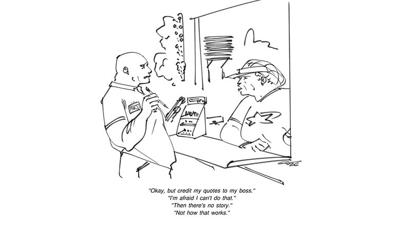
Can you attribute my quotes to my boss?
Believe it or not, I have been asked this question, and the answer is no.
Decades ago, I was tasked with writing a piece about a business and after interviewing the guy I was told to call, he asked me this.
The journalists I know try to present information as accurately as possible, despite what others may think. As such, it would be irresponsible to knowingly attribute a quote to the wrong person.
Can I read the story before it’s printed?
In general, no.
There may be situations where points of a story are so technical in nature that it behooves everyone involved to have the source read all or part of it prior to publication. However, these situations are rare.
Logistically, it would be impossible to get a paper out each week if we allowed all sources to read their stories before they go in the next edition.
I usually tell people that it wouldn’t matter if my story were about the governor or the local dog catcher, the person does not get to read what I wrote until it’s in the paper.
Can you cover our event this weekend?
The papers I’ve worked for send reporters to a fair number of weekend events, but you cannot get to everything. Sometimes, the number of events happening at the same time is overwhelming.
My advice to those putting on events is to alert the paper as early as you can about your event. We encourage them to send the information to news@myleaderpaper.com, our common email address for our newsroom. If you want to send follow-up emails about it as you approach the event, that’s fine.
A problem is that we’ll get a call on a Thursday about an event the caller would like us to cover in two days. It is not likely at that point we will have someone available to get to the festival, dance, meat shoot or whatever you have planned.
Here are a couple of questions I remember getting during my days as a sportswriter when I mainly covered high school athletics. I have worked as a sportswriter in Jefferson County and St. Louis County, as well as across the river in Monroe County, Ill.
Why do you keep writing about (another team) and not ours?
The sportswriters I know try to cover the best story, not a preferred school. If one high school team happens to be doing well, there likely are more interesting tales to tell about the team than another one not doing as well.
Why do you ignore my kid’s sport?
While it is common sense that sportswriters focus on the sports that attract the bigger crowds, it does not mean they won’t write stories about others.
One of the more interesting sports stories I remember writing was about a Monroe County teen who was into sailing. The kid competed in events at Carlyle Lake, among other bodies of water. It is the only story about sailing I recall ever having written.
Here is one last question I’ve heard from the public, this one concerning photography.
Can you make me look good (or thinner)?
All I can respond with is, “I’m a writer trying to take your picture, not a magician.” I say this in my head.
I usually just chuckle with the person and take the photo.