
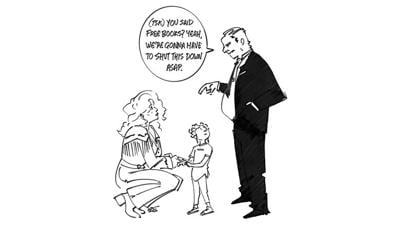
When I was pregnant with my son, I checked into signing him up for the Dollywood Foundation’s Imagination Library literacy program, which mails one age-appropriate book for free every month to children from birth to age 5.
I loved the story behind the Imagination Library, which I had learned about several years earlier while visiting Dollywood in Pigeon Forge, Tenn. Dolly Parton, the singing and songwriting legend, was inspired by her father’s inability to read or write and decided to do something to improve literacy and inspire a love of reading in children.
She started the Imagination Library program in 1995 to distribute books to the impoverished county where she grew up in Tennessee, and the program was soon after adopted statewide.
Unfortunately, when I checked the registration process on Imagination Library’s website, I found the program was not available in our zip code. However, I put my son’s name on the waiting list to be contacted if it ever became available. And miraculously, before he turned 1, I was emailed a notification that Missouri had partnered with the Dollywood Foundation to make the program available.
While the books are free to families, the program is made possible through shared funding between the Dollywood Foundation and local community partners, such as charities or the government.
The local partner pays for the books and postage. The Dollywood Foundation handles the operational side by selecting, ordering and mailing the books, typically only costing about $2.60 per month per child for the book and postage combined.
Prior to the statewide expansion in 2023 that brought the program to all 114 Missouri counties, it was only available in limited communities through local school districts and nonprofit partnerships.
I was honestly shocked at the partnership’s approval, given our legislature’s typically do-nothing nature. I rushed to sign up before they realized they’d accidentally done something nice for people whose financial status didn’t end in “illionaire.”
Unfortunately, it turns out that after two years of the program, the Missouri legislature did eventually notice they were funding something that made the world a nicer place and decided that was quite enough of that, thank you very much.
On June 2, I received an email from the Dollywood Foundation that despite 170,000 Missouri children receiving a book from Dolly each month, the current Missouri state budget was cutting funding from the program from $6 million to $2 million for the 2027 fiscal year.
“Because of that reduction, the program will close to new enrollments on July 1, 2026.
“If your child is already enrolled, books will continue arriving until the funds run out. We expect that to happen within four to six months.”
I know saving $4 million sounds like a lot to most of us. However, the 2027 state budget is nearly $51 billion. A $4 million savings is approximately .007843 percent. That translates to about one penny for every $127.50 of the budget.
It’s such an insignificant amount that it makes you wonder what is the point of cutting it at all if not just to take books out of the hands of children whose families can afford them the least?
At a cost of about $1 per resident per year to fully fund the program, it seems like a no-brainer to keep funding it.
I’ve seen online commenters say, “Why don’t people just take their kids to the library if they can’t afford to buy their own books?”
I get it, just zipping off to the library sounds easy for those who already have easy access to library resources. However, public libraries are not accessible to everyone in the state, especially in low-income and rural areas.
Where I grew up, the closest library was a 30-minute drive from my house, and because we didn’t live in that town, I wasn’t allowed to have a library card to check out books. I had to read them while sitting in the library. Because my parents both worked full-time, the only day we could go to the library was on Saturday for the four hours the library was open.
Don’t get me wrong, I love libraries and will champion their value any day of the week. But is it really fair to say that public libraries are always a good alternative to having books at home?
Studies show that simply having books in the home can make a big impact on a child’s educational trajectory. Children with as few as 20 books at home complete an average of three more years of schooling than those who grow up in homes without books. Whether rich or poor, having books in the home is one of the biggest factors in educational longevity.
Let’s talk about return on investment. Every additional year of education can add thousands of dollars to lifetime wages.
According to Forbes, the median lifetime earnings of someone without a high school diploma is $1.2 million; those with a high school diploma average about $1.6 million; with an associate’s degree averages $2 million; and with a bachelor’s degree, $2.8 million.
Spending $2.60 a month to get those bumps in lifetime wages seems like one of the cheapest investments with the biggest payoffs possible.
The Dollywood Foundation encourages people to contact their local state representatives to share how meaningful Dolly Parton’s Imagination Library has been to their families and ask for funding for the program to be restored.
I encourage everyone to tell their representative that Missouri children are worth every penny of the Imagination Library program. Especially if it’s only one penny out of every $127.50 spent.
OUR OPINION: Access to food is basic human right
By Leader staff
About one in seven Americans experiences food insecurity or a lack of access to an affordable, nutritious diet.
That startling ratio came from the 2025 Household Food Security in the United States report, which was the last the United States Department of Agriculture produced on the state of hunger in the nation.
It’s a battle that’s waged across the nation and continues today.
Jefferson County is fortunate that several organizations are on the frontlines of that battle and are striving to improve access to food.
One of those organizations, the James II Project, has recognized the growing need to address food insecurity and is expanding its free meal program to High Ridge.
The James II Project started in June 2023 by partnering with the Salvation Army of Jefferson County, which is just outside of Arnold city limits.
The organization started by serving lunch from 11:30 a.m. to 12:30 p.m. on Tuesdays in the Salvation Army’s worship and community center, 3740 Telegraph Road.
A little over a year later, a second lunch was added from 11:30 a.m. to 12:30 p.m. on Thursdays at the Salvation Army.
Then in February 2025, the organization expanded its mission to Festus, serving lunch from 11:30 a.m. to 12:30 p.m. on Mondays at the First United Methodist Church of Festus-Crystal City.
About a year later, a fourth meal was started.
On June 2, the group began providing a meal from 4-5 p.m. on Tuesdays at the St. Anthony of Padua Catholic Church, 3008 High Ridge Blvd., in High Ridge. Forty meals were served on that first evening.
As the program has grown, so has the number of volunteers and partners.
“We have 200 volunteers now, and they are amazing,” said Karin Kostich, executive director of the James II Project. “We couldn’t do it without our volunteers. I could never have imagined it being like this. I just sit back and I am constantly in awe. I would never have thought I would do this, and I am excited to do it every day.”
Food is a basic human right that is essential for survival and dignity.
And the work of nonprofits such as the James II Project fills a void for many of our neighbors in the hope of creating a stronger and healthier community.
For that work, we are thankful and the county is blessed.