


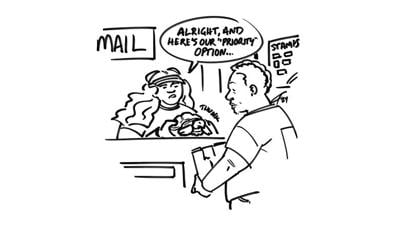

If you’re wondering if the mail has gotten slower and less reliable in the past few years, you’re not alone.
Last April, many Jefferson County residents complained that they received their voting information cards days or weeks after the election, despite the materials being sent well ahead of time. Other people, including recent Leader letter writers, have complained about bills, tax documents and medications, all of which can lead to complications if not received in a timely fashion.
It has many of us wondering how why the U.S. Postal Service, a nearly 250-year-old organization, is getting worse at delivering mail.
The USPS, one of the few government agencies explicitly authorized by the U.S. Constitution, generally receives no tax dollars to cover its operating expenses, but instead relies on the sale of postage, products and services to fund itself.
To see where the recent USPS problems started, we must look back to 2006 when the Postal Accountability and Enhancement Act (PAEA) was passed. It required the USPS to pay in advance for its employees’ health and retirement benefits, while at the same time requiring the USPS to cap postage pricing by not increasing it faster than the rate of inflation. It also mandated the USPS to make deliveries six days a week instead of five.
The law added a massive financial obligation (about 5.5 billion per year) to the USPS’s bottom line while simultaneously preventing it from raising revenue. The effect was almost immediate. The USPS went from making a net income of $900 million in 2006 to a loss of $3.8 billion by 2009.
The losses continued, and from 2007 to 2016, the USPS lost $62.4 billion. The USPS inspector general estimated that 87 percent of the losses were due solely to the requirement to pre-fund retiree benefits.
As news of the massive losses came to light, I heard people say that the USPS debt was proof government doesn’t work and call for the USPS to be scrapped and all mail delivery to be privatized. It made me question whether that was really the goal for PAEA – to get people on board with the idea of eliminating the USPS and privatizing mail delivery. When the USPS was pulling in almost a billion dollars a year in income, I imagine private companies were eager to get into that market.
One of the problems with that idea the USPS is required to deliver mail to every home in the U.S., but if the mail system were privatized, it’s unlikely that same mandate would exist, leaving those in rural areas without mail service or service at a steep price. Currently, other delivery services, like Amazon, hand off packages to the USPS for the “last leg” of deliveries to rural areas because they, themselves, don’t want to deliver there.
The first time I noticed mail delivery getting worse was in 2012 when I lived in Cape Girardeau and heard the announcement that the USPS needed to consolidate mail processing and distribution facilities to remain viable. The processing center in Cape was closed and those operations were transferred to St. Louis.
Suddenly a piece of mail from Jackson, just 10 miles away, took close to a week to arrive when it previously took one or two days.
Then, things seemed to change from bad to worse under the leadership of Louis DeJoy, a large political donor with no USPS experience who was appointed to the position of postmaster general in 2020. DeJoy was founder and CEO of a logistics and freight company called New Breed Logistics. His companies still have service contracts with the USPS, which has generated conflict of interest complaints.
DeJoy quickly made changes to the USPS, including eliminating overtime, banning late or additional trips to deliver mail, decommissioning more than 600 high-speed mail-sorting machines and removing lower-volume mail collection boxes from streets. After that, people began noticing significant delays in mail delivery.
In March 2021, DeJoy issued a 10-year plan called “Delivering for America” that included slowing down first-class mail delivery, cutting post office hours and raising prices. The plan included Congress rescinding the requirement for the USPS to pre-pay retiree health care costs, which it did with the Postal Service Reform Act of 2022.
Part of slowing down the mail included shifting some long-distance, first-class mail from air transport to ground transport and slowing some previously three-day mail to four-day and five-day mail. At the time, the USPS said delivery times would be slower but more reliable.
However, a lot of mail isn’t making it on time, even with the longer four- and five-day delivery times. According to the USPS website, in the Kansas-Missouri district, two-day mail was on time 90.5 percent of the time in 2023. In 2024, it’s 86.5 percent. In 2023, three-to-five-day mail was on time 78.3 percent of the time. In 2024, it’s 64.1 percent.
As postmaster general, DeJoy has made his priority maximizing profits, not improving services for the American people.
The USPS is meant to be a service for people in the U.S., not a for-profit business. Expecting the agency to make a profit is not necessarily a reasonable ask. The military budget was almost $900 billion dollars last year, yet I think you’d be hard pressed to find many people refer to that service as a nearly trillion dollar yearly “loss.”
There are options that could make the USPS more profitable without making mail delivery slower and more unreliable, which will further discourage people from sending mail and hurt the agency’s bottom line.
The USPS could expand to include other services, like issuing hunting and fishing licenses. Others have suggested adding “Postal Banking,” which would have the USPS offer savings accounts, check cashing, small loans, money orders, bill payment, money transfers and prepaid cards.
A 2014 USPS inspector general report suggested the agency could earn $8.9 billion per year in revenue by providing financial services, like it did from 1911-1967 with the Postal Savings System. According to the American Postal Workers Union website, more than 17,000 post offices are located in ZIP codes where only one or no bank branches are located. By offering basic financial services at the post offices in those areas, the USPS could serve the public, stay relevant and stabilize their finances.