


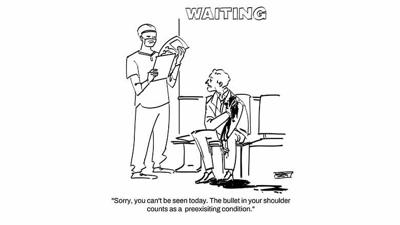

After the recent death of Brian Thompson, the CEO of UnitedHealthcare who was shot and killed in Manhattan on Dec. 4, many people responded not with sympathy, but instead with contempt, mockery and even glee. Some even said they thought he deserved to die.
UnitedHealth Group posted a message on Facebook expressing sadness about Thompson’s death, and the post attracted thousands and thousands of reactions, the majority being laughing emojis.
While I don’t condone violence, I was not surprised by the lack of sympathy about Thompson’s death.
Americans pay more for health care than people in other large, wealthy countries. Government data shows that over the past five years, spending on insurance premiums, out-of-pocket co-payments, pharmaceuticals and hospital services has increased. Despite having the most expensive health care in the world, America barely ranks in the top 50 in life expectancy.
A recent U.S. Senate subcommittee report showed UnitedHealthcare’s use of artificial intelligence to automate claim decisions increased the insurer’s prior authorization denial rate for post-acute care from 10.9 percent in 2020 to 22.7 percent in 2022. A class action suit filed against UnitedHealth Group in November 2023 alleged the company knew the AI model they used had a 90 percent error rate.
According to those statistics, more than one in five insured people are denied necessary health care because a stupid robot said no to a claim.
These denials have very real consequences for people, whether it’s having to delay care while they try to appeal the denial, paying out-of-pocket for care or forgoing needed care altogether. Sometimes forgoing that care leads to death.
After Thompson’s murder, I saw people online sharing stories about their own insurance claim denials. One woman said her insurance company denied her surgery for breast cancer two days before it was scheduled because it wasn’t considered an emergency. Luckily, the decision was reversed after an appeal, but she said the whole ordeal put an incredible amount of stress on her during an already terrible time.
Another woman told a harrowing story about being sexually assaulted by a stranger and going to the hospital for a rape kit and pills and shots to prevent pregnancy and STDs. Her insurance company told her that before her claim could be approved, she’d have to show that authorities had charged her rapist with a crime. The police had not caught her attacker, so the woman had to pay out-of-pocket for treatment after being raped.
Another man shared that his diabetic mother’s insurance company suddenly denied her medical supplies. When she died six months later, her insurance company delivered her needed supplies. Her death had triggered the insurance provider to decide that her diabetes was necessary to treat.
I saw story after story about people being denied needed care, including people who thought they had good insurance and were properly covered, only to be hit with unexpected expenses after a medical emergency, landing them in great financial hardship. It’s worth noting that nearly two-thirds of bankruptcies in America are related to medical debt.
Obviously, we never want to accept violence as a solution to a problem. I think there’s a far better answer to curtailing corporate greed than murder. But, I can understand how someone could be consumed with rage after seeing a loved one suffer or die from an insurance denial.
Thompson did not personally kill anyone, but there is no doubt the health care company he led caused countless people unnecessary suffering, and possibly death, by denying and delaying claims.
In a country that routinely sees mass shootings at shopping centers, concerts and school classrooms, we’re used to our leaders mumbling about sending their thoughts and prayers before telling us to get over it and get back to business as usual before the victim’s bodies are even cold. Is it any wonder, then, when a rich man who made his wealth by denying people life-saving medical care is shot and killed, that people who are increasingly becoming numb to mass deaths aren’t wringing their hands and calling for “justice?”
In 2023, UnitedHealth Group reported $22 billion in profits. That’s $22 billion the company collected from customer premiums and then denied claims for countless people when they needed medical care the most. The idea that these companies are profiting off of someone else’s health, and to such an astonishing degree, is morally obscene to me.
Health insurance companies make profits by denying claims. Relatively few people try to fight the insurer when they turn down their claims, with many saying they didn’t know they had the right to do so or didn’t know who to contact.
If you get a denial letter for care you need, don’t immediately give up. You have the right to appeal the company’s decision. Insurers must tell you why they’ve denied your claim and how you can dispute their decision.
There are two ways to appeal a claim denial – internal appeal and external review. For an internal appeal, you may ask your insurance company to conduct a full and fair review of their decision. With companies using AI to deny claims, it’s possible that an internal appeal may get the claim in front of a human who will reverse the decision. You may also ask your health care provider to contact your insurance company to request reconsideration.
If you don’t receive a satisfactory solution from an internal appeal, it may be time for an external review. In an external review, an independent third party reviews the appeal and decides whether or not the insurance company must pay the claim. The insurance company does not have the last say on whether you receive care.
These companies are counting on you to see that first denial letter and give up. Don’t.