


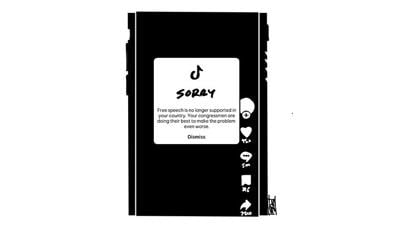
On the morning of Sunday, Jan. 19, I opened one of my favorite apps to see a message I expected, but still hoped not to see:
“Sorry, TikTok isn’t available right now. A law banning TikTok has been enacted in the U.S. Unfortunately, that means you can’t use TikTok for now.”
Access to TikTok was restored in less than a day, and President Donald Trump has signed an executive order, giving TikTok another 75 days to find a U.S. buyer before it’s banned, as Congress had ordered.
It was the first time the U.S. government outlawed any social media platform, which I think is a pretty big deal. Yet, I saw many people who don’t use TikTok scoff, belittle and dismiss the ban as unimportant.
Those who never used TikTok may think of TikTok as “that dancing app,” but it certainly isn’t that narrowly focused. TikTok content is as varied as its nearly 1.6 billion users globally, 170 million of who live in the U.S.
TikTok tailors its content to you based on the videos you like and interact with, as well as what you search for. It takes that information to create a “For You Page,” or FYP as TikTokers call it.
My own FYP is filled with a variety of topics, such as book reviews; cooking; gardening; crocheting; sewing tutorials; home cleaning and remodeling; cute animals; news; politics; and cow hoof trimming.
I joined TikTok in 2020 out of boredom during the pandemic. I quickly realized it was a fantastic resource to find communities of people with similar interests. Feeling connected to other people was essential during a time when I rarely saw anyone other than my husband. When COVID made the world small, TikTok made it feel bigger again.
When I became pregnant during the pandemic, I followed digital creators who were OB/GYNs and labor and delivery nurses who discussed what to expect from pregnancy and childbirth. After my son’s birth, when I was struggling with breastfeeding, I watched lactation consultants for helpful tips. This information was so valuable as a first-time mom.
Parent groups weren’t available to me in the real world, but I was able to follow other parents with young children on TikTok and watch their children hit their milestones around the same time as mine. I learned games to play and songs I could sing with my son.
While people often talk about how much time they waste on TikTok (and boy, have I ever), it’s also saved me a ton of time on an everyday basis. TikTok has for the most part replaced Pinterest and YouTube for me, my previous two go-to apps for how-to’s. I can’t tell you how many times a day I search TikTok for how-to videos. What’s the best way to make a homemade Italian dressing? What’s the best way to sew this zipper? What local restaurants should I go to while on a weekend getaway?
I truly enjoy TikTok and believe it has created a community in a time when the town square has vanished. That’s why I’m puzzled that is has been labeled a threat. We’ve been told that TikTok is bad because it’s owned by a Chinese company, ByteDance, and we should be scared of them collecting our data.
But if TikTok is so dangerous, why do Donald Trump, Kamala Harris and many other members of congress have TikTok accounts? Surely their data is far more valuable than the average user’s.
My illusion of data privacy went out the window at least a decade ago.
According to an NPR report, the amount of data TikTok collects is on par with apps owned by American tech companies. You can’t even sneeze or cough in the comfort of your own home without suddenly being inundated with ads for cough syrup or allergy medications across social media apps. And if you do any online shopping, expect to see ads for every product you looked at popping up for the next month. Yet people aren’t pushing to ban other social media apps, such as Facebook, YouTube, Instagram or Twitter.
That’s not to mention the constant data breaches at U.S.-based companies. I feel like hardly a month goes by when I don’t receive a notification that a company has had a data breach where my address, phone number, Social Security number and shoe size have been leaked and put onto the dark web.
I can’t fathom what dangerous information TikTok is collecting about me. And even if they were collecting valuable information, our country spends more than $800 billion dollars a year on defense. If TikTok knowing that I took a walk at a park, purchased a pair of leggings online or watched an episode of Great British Bake Off puts our national security at risk, we need to have a serious conversation about why we are spending so much money on defense.
Restricting access to foreign media is a hallmark of repressive governments. Right now, 19 countries have a total ban on TikTok, including Albania, Afghanistan, India, Iran, Jordan, Kyrgyzstan, Nepal, Senegal, Somalia, Uzbekistan. Do we really want America to be the type of place where our government tells us who we are allowed to listen to?
Other countries, such as Britain, Australia, Austria, Belgium, Canada, Denmark, France, Netherlands, Ireland, New Zealand and Norway have partial bans, prohibiting access to the app on the work devices of lawmakers, civil servants and other government employees. This seems like a much more reasonable solution if the concern of TikTok truly is about data protection.
Whether you’re a TikTok fanatic or you’re somebody who rolls their eyes whenever it’s mentioned, you should have the right to use, or not use, any social media platform you wish. If we ban TikTok, the question you should ask is: which one is next?