
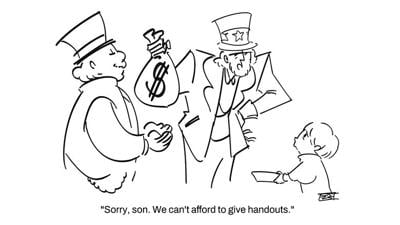
Whenever a federally funded program comes up in conversation, whether it be single-payer health care; free preschool or college; free school lunches; paid parental leave; student loan forgiveness or other programs that benefit someone younger than 65, I often hear the same reaction:
“Those programs aren’t free! They’re paid for by taxes. Why should I, as a taxpayer, be required to pay for that when it doesn’t benefit me?”
First of all, everyone knows those programs aren’t free and are funded by taxes. The “free” indicates free at the “point of sale.”
Secondly, for those who missed the memo, you are not the only person who pays taxes. People from every demographic pay taxes. Democrats, Republicans, city dwellers, country folks, men, women and even children. (I distinctly remember being 16 and seeing a chunk of my meager pizza parlor paycheck taken out and wondering how it was legal to tax me since I wasn’t old enough to vote. My history class at the time definitely mentioned something about no taxation without representation.)
Nobody is asking you to send them a check. People simply want the taxes they have paid to go into programs that benefit them and those they care about.
I’ve paid tens of thousands of dollars in taxes during my life, and so far the only benefits I ever received were the couple of $1,400 pandemic checks everyone was given. Is it so outlandish for me to want to see government programs benefit me in some way? Why must I wait until I’m elderly to “deserve” to get any return on my investment?
Besides, by the time I’m in my twilight years, the retirement age for Social Security could be 85 and the benefits might amount to one coupon for a free soft-serve ice cream cone per month … if it even exists at all.
Why should I be happy to pay my taxes when the money goes toward corporate bailouts and endless wars? Our tax system often benefits the wealthy, but why is it that if I advocate for anything that would benefit me or any other non-rich person, like paid parental leave, some people want to label me as a parasite to society? Heaven forbid that during my entire adult working life I could spend 12 weeks on the receiving end of tax money, rather than the giving end!
Many people have moral objections to how their tax dollars are spent: the pacifist whose taxes fund the military; the vegan whose taxes subsidize cattle and hog farms; the environmentalist whose taxes fund fossil fuel subsidies; the mom-and-pop store owners whose taxes go to help the low-wage employees of their big box competitors. The list goes on.
Even those who don’t face moral dilemmas pay taxes for programs that don’t directly benefit them, like the urbanite whose dollars are spent to pay farmers in the Conservation Reserve Program, the childless adult whose taxes are spent on local schools and the agoraphobe whose taxes fund parks. If we could each check boxes for how we want our tax dollars spent, this would be a very different country. I certainly wouldn’t choose for my tax dollars to pay crooked politicians or to bail out reckless banks.
I don’t have any school-age children, but I still happily pay taxes for schools. In fact, I wish more of my taxes went to schools so we could have robust pre-kindergarten programs and free college and technical school tuition. Having a well-educated population is a benefit to everyone.
But when the topic of student loan forgiveness comes up, a certain portion of the population loses their collective mind at the thought. “They chose to go to college! They agreed to the loans! Why should my tax dollars pay for their education?”
The student loan forgiveness program allows forgiveness of $10,000 to $20,000 per borrower. Those who go to college most likely will be in the work force for at least 40 years. During that time, they will almost certainly pay many times over that amount in taxes. So whose taxes are going to pay for student loan forgiveness? The people receiving the loan forgiveness, it would seem.
I remember during an online discussion about making breakfast and lunch free for all school children, one passionately opinionated commenter said, “Why should my tax dollars pay for your kid to eat? If you can’t pay the same $1.35 per meal I do for my kid, then you shouldn’t have kids!”
Another commenter whose child went to the same district pointed out that $1.35 was the reduced lunch price and the full price for school lunch was $2.60. The first person was talking about not wanting his tax dollars to benefit other people’s children while personally using other people’s tax money to feed his own children. He saw no irony or hypocrisy to his argument.
It is astounding the number of times I have heard a person express the opinion that “programs benefiting me are great because I’m a deserving, hard-working taxpayer, but programs benefiting anyone else are bad because they’re blood-sucking leeches.”
Children who receive free meals are going to be the next set of taxpayers. Right now they’re on the hook for more than $38 trillion they clearly had no part in creating or benefiting from. It doesn’t seem fair to deny them food, proper education or any social benefits but expect them to foot the bill for things that happened before they were born.
Nobody likes taxes. But it feels especially painful paying them when we get so little in return. Other countries have universal health care; free pre-K and college; free quality eldercare; paid maternity and paternity leave; robust retirement and social welfare programs; quality infrastructure and readily available mass transit options.
We get a trillion dollars in defense annually, generous handouts to billionaires, a few social programs limping along on fumes and not much else. And when it’s time for budget cuts, it’s never the first two that get the trim.