
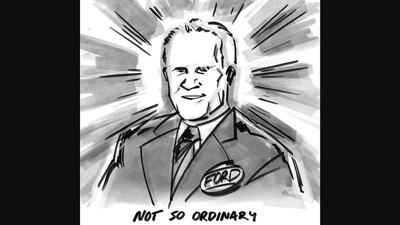
Jerry, we hardly knew ye.
As another overheated presidential election barrels toward the finish line, let us pause to remember a remarkable chief executive unfairly relegated to the back shelf of American history.
Fifty years ago, on Aug. 9, 1974, Gerald R. Ford took the oath of office as our 38th president. His predecessor, Richard Nixon, had resigned the presidency at noon that day, flying away on a helicopter with the two-year wreckage of the Watergate scandal strewn behind him.
Ford had not campaigned for the job but agreed to serve as Nixon’s vice president after former veep Spiro Agnew resigned in December 1973 rather than face trial for multiple bribery offenses.
When Nixon’s house of cards collapsed, there stood Ford, the only chief executive in American history not to be elected either president or vice president.
“My fellow Americans, our long national nightmare is over,” Ford said. “I am acutely aware that you have not elected me as your president by your ballots, and so I ask you to confirm me as your president with your prayers.”
Most Americans didn’t know much about Ford, who had represented western Michigan in Congress for 25 years, rising to Republican minority leader in 1965. He earned a reputation for integrity and devotion to bipartisanship, demonstrated in his work to pass the landmark Civil Rights Act of 1964 and the Voting Rights Act of 1965.
But his political philosophy, dictated by his conservative Dutch Reformed Church roots, was to avoid self-promotion and let his legislative achievements speak for themselves.
For two of his most notable accomplishments as president, he invoked the same executive authority that Abraham Lincoln used in issuing the Emancipation Proclamation during the Civil War.
A month after taking office, Ford declared a full pardon of Nixon, triggering a firestorm of public outrage. Ford’s approval rating as measured by the Gallup Poll plummeted overnight from 71 percent to 50 percent, and he was falsely accused of cutting a deal with Nixon to attain the White House.
Just eight days after the pardon, he caught more heavy flak for granting conditional amnesty to Vietnam War draft-evaders.
All this and much more is richly detailed in Richard Norton Smith’s 2023 Ford biography entitled “An Ordinary Man.” At 710 pages, not counting another 73 pages of footnotes and annotations, it’s a heavy lift, but lovers of American history will lap it up.
It’s one of my “summer reads” and has reinforced my high regard for this underappreciated leader.
The Nixon pardon and amnesty program, from the perspective of 50 years, were what the country needed to move on from two of the greatest debacles of the 20th century. In his 895 days in office – the shortest term by any president who didn’t die on the job – Ford compiled a mixed record on the economy as inflation and recession created “stagflation.” He mounted a “Whip Inflation Now” (WIN) campaign that encouraged Americans to reduce their spending and wear their WIN buttons; the campaign flopped.
Ford had his successes:
■ Completed the evacuation of Americans and tens of thousands of Vietnamese with the end of the Vietnam War in April 1975.
■ Signed into law the legislation that established special education programs in public schools nationwide.
■ Bailed out a bankrupt New York City with a conditional $2.3 billion federal loan.
■ Rescued the merchant ship Mayaguez after it was captured by Cambodian Khmer Rouge pirates.
History also has marked Ford as unique among our 46 presidents, besides his being unelected. Ford is:
■ The only president who was an Eagle Scout.
■ The only president to survive not one but two assassination attempts, only 17 days apart in September 1975.
■ The only president to testify to Congress, which Ford did in defense of the Nixon pardon.
As the Smith biography recounts, Ford was heroic long before he became president. As a ranger at Yellowstone National Park in 1936, he rescued a hiker dangling from a steep cliff.
In World War II, Ford was nearly killed twice while serving as an officer on the aircraft carrier Monterey.
Unfortunately, when many people of my generation think of Ford, they recall two big stumbles. He fell down steps exiting Air Force One and TV comedian Chevy Chase lampooned him mercilessly in the early days of “Saturday Night Live.”
In a presidential debate with Jimmy Carter in 1976, Ford declared, “There is no Soviet domination of Eastern Europe.”
Ford lost that 1976 election to Carter by 2.1 percent. The Nixon pardon probably cost him the presidency.
A 2021 survey of 150 presidential historians ranked Ford 28th, just below Carter (26th) and James Garfield (27th), who served only 199 days, and one notch above George W. Bush. (I don’t know what the historians were smoking when they ranked Ulysses S. Grant 20th, way up from 33rd in the 2000 survey. But that’s another story.)
Side note: Carter came to Columbia when I was a senior at Mizzou and I saw him in person at the jam-packed Stephens College auditorium. Later on, closer to Election Day (and my first presidential vote), I shook hands with Sen. Bob Dole, Ford’s running mate, when he stopped by Columbia.
I voted for Carter. He opened his inaugural address this way: “For myself and for our nation, I want to thank my predecessor for all he has done to heal our land.”
That still says it all, 50 years later.