
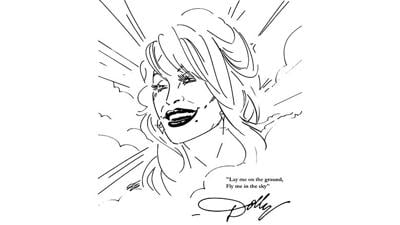
An April 2026 poll of 1,000 Americans found that the most beloved public figure in the country was not a politician, religious figure or even an athlete, it was the Queen of Country herself, Dolly Parton.
Dolly ranked above former President Barack Obama and Ukrainian President Volodymyr Zelenskyy in terms of favorability in the poll conducted by the University of Massachusetts.
In our increasingly divided world, Dolly was seen by many as one of the last unifying figures who was praised for her philanthropy, humor, fashion and, of course, her talent.
When news broke of her death at age 80 on Aug. 25, I was on my lunch break in my car and couldn’t believe what I was hearing. It didn’t feel real. Dolly was one of those celebrities who you would never think would die. I’ve never known a world without her in it. Four days before her death, Dolly had told People magazine, “I still have so many things I want to achieve, so I’m gonna keep on working as long as I can to see everything come to life.”
I first remember being introduced to Dolly through her appearances on the Disney Channel sitcom “Hannah Montana” as Miley Stewart’s (Miley Cyrus) Aunt Dolly.
If it weren’t for this, I – and probably many others in my generation – wouldn’t be familiar with the Grammy winner.
Dolly admitted as much to Cyrus, her real-life goddaughter, in a “Hannah Montanna” 20th anniversary special that was released earlier this year.
In her lifetime, Dolly wrote more than 3,000 songs and released 49 studio albums. Several of these songs, such as “I Will Always Love You,” “Jolene” and “9 to 5,” have become cultural cornerstones not just in America but the entire world.
In her 2020 book “Dolly Parton, Songteller,” Dolly said she probably wrote “Jolene” and “I Will Always Love You” on the same day in 1973. According to The New York Times and Billboard magazine, “Jolene” has been covered more than 100 times by everyone from The White Stripes to Beyonce.
And who could forget Whitney Houston’s cover of “I Will Always Love You” for “The Bodyguard” soundtrack?
In 2018, Dolly humorously said in an interview, “People always tell me, ‘I thought that was Whitney’s song. I didn’t know you wrote it. I thought she wrote it.’ And I tell them, ‘She can have the credit. I’ll just take the cash.’”
Unfortunately, I never saw Dolly live in concert, but she was a great live performer who could command an audience with her natural charisma.
My own personal favorite Dolly song is “Here You Come Again.” Even though she didn’t write it, Dolly delivers the lyrics with so much conviction it doesn’t matter.
I also loved Dolly’s dry and at times dark sense of humor about her appearance, her upbringing and the world.
One of my favorite Dolly-isms is when she would say, “I’m not offended by all the dumb blonde jokes because I know I’m not dumb and I know I’m not blonde either.”
Dolly had a memorable career on the big screen.
I have fond memories as a kid watching “Steel Magnolias” on TV. Dolly’s character, Truvy Jones, is a small-town hairdresser who runs her salon out of her own home and gossips with her clients. Whenever I watch that movie, it always reminds me of going with my mom to get haircuts at her friend’s basement salon.
Another great Dolly film role is in “The Best Little Whorehouse in Texas” opposite Burt Reynolds. I only watched this movie two years ago, but Dolly’s rendition of “Hard Candy Christmas” is particularly memorable. I also really enjoy the final scene when she tearfully sings “I Will Always Love You” to Reynolds’ character as a last goodbye.
My favorite Dolly performance has to be her first. In the 1980 film “9 to 5,” she plays a secretary, Doralee, sick of the advances of her chauvinistic boss (Dabney Coleman). In the movie, Doralee bonds with her coworkers, Violet and Judy, played by Lily Tomlin and Jane Fonda, to put their boss in his place.
Dolly’s performance is both hysterically funny and endearing, which is impressive especially for a first-time actor. Arguably the best scene in the movie is when she confronts her boss Frank in his office after it is revealed he has been telling the office they’ve been having an affair. Dolly gives a great monologue in the scene and ends it with the classic line, “I’m gonna change you from a rooster to a hen with one shot!”
Dolly was nominated for an Oscar for writing “9 to 5” in 1981 and again for writing “Travelin’ Thru” in 2006 for the film “Transamerica.” In 2025, Dolly was awarded the Jean Hersholt Humanitarian Award from the Academy of Motion Picture Arts and Sciences for her philanthropic work.
In recent years, it almost seemed like Dolly’s work as a humanitarian drew more attention than her musical achievements.
She was recognized for many charitable efforts throughout her life, but Dolly’s most well-known effort may be the Imagination Library, which was originally founded in 1995 as a book giving program for children in Dolly’s home county in eastern Tennessee. Thirty-one years later, the program has given more than 300 million books across five countries including the U.S., Canada, the United Kingdom, Australia and Ireland.
I was appalled when the state of Missouri recently made millions of dollars in budget cuts to the Imagination Library that froze enrollment. In the wake of Dolly’s death, that money should be reinstated to the program so that kids across the state can discover the love of reading.
The word iconic is thrown around a lot these days, but Dolly is the true definition of the word. Even though she’s not with us anymore, we will always love her.