
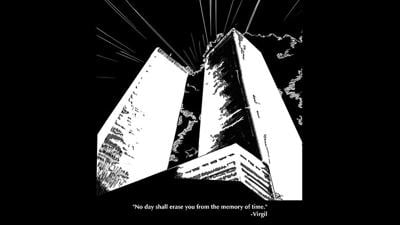
Sept. 11, 2001, was a turning point for America.
For most of us, there was a life before the terrorist attacks that killed nearly 3,000 Americans on that clear, sunny morning.
And there was just as clearly life after those attacks on American soil.
The moment of change was when two hijacked airplanes crashed into the World Trade Center in New York, another crashed into the Pentagon and a fourth plane was brought down in a Pennsylvania field after heroic passengers fought back against the terrorists.
After that day of unspeakable tragedy, life in America changed.
For most Americans, the moment when they learned of the attack and watched it unfold is seared into their memories and souls.
For me, I had just awakened after a late-night shift on the copy desk of the Joplin Globe. Shortly after the first plane crashed into the World Trade Center, my wife directed my attention to the TV morning show hosts who were trying to ascertain what had happened. At the time, the assumption was that it was a single, horrific accident in the heart of New York City.
But as I rubbed my eyes and tried to focus on the TV screen, I then saw the second airplane crash into the same building.
It was no accident; it was an attack.
Looking back today, other memories of that morning are cloudy and convoluted. I know I quickly prepared to go into work as I tried to make sense of what had happened and how my role as a journalist could help folks understand and cope with the tragedy.
In three short hours, a handful of journalists produced a “bulldog” edition about the attacks and how the community was responding. On that day, the Globe, which delivers its news in morning editions, opted to publish a special, early edition that hit the streets 12 hours before the next day’s issue would have been printed.
Time was of the essence, and there was intense hunger for more information.
We all struggled with questions that simply couldn’t be answered in those first hours and days after the attack.
Who had done this to us and why?
How were they able to use our own aircraft against us?
And most importantly, were there going to be more attacks?
That “bulldog” edition was our initial attempt to begin to answer those questions.
The Globe had employees standing on busy street corners, handing out the free update on the attack. The streets grew congested as long lines of cars converged in hopes of getting a copy of that day’s edition.
With that edition on the streets, we turned immediately around and began working on that next morning’s edition, which would chronicle the latest news on the nation’s response to the attacks, as well as how the community was banding together for this new life.
As a society, we were all faced with fathoming how our lives before the attacks would now be changed.
Among those on the front lines of trying to make sense of this new life were the nation’s educators.
In America’s classrooms, millions of students – and then-President George W. Bush – were at school that September morning when the crisis unfolded.
In what became an iconic snapshot of that day, Bush was reading to a classroom of Florida students when his chief of staff leaned down and whispered into his ear, “America is under attack.”
Across the nation, teachers and students learned of the attacks in real time, as they watched newscasts on box TVs strapped to rolling carts. The scene led to a mix of confusion, fear and a need for emotional support. Teachers gathered in hushed conversations and attempts were made to explain to students what was happening or to shield them from the events.
In our edition today, reporters Sarah Lerch, Kate Bequette and Carrson McDaniel talked with local educators who shared how they first learned of the attack, as well as how the lessons of 9/11 changed the nature of American education.
In one of the stories, former teacher Judy Smith, who taught second grade in the Fox C-6 School District in 2001, recalls the principal instructing teachers to turn off the televisions because it was upsetting to some students.
“I just know it just put a cloud, just such a heaviness over everybody, over all the teachers,” Smith said. “At lunch time, everybody was trying to get to the teachers’ lounge to turn the TV back on and find out what was going on.”
Weeks and months after the attacks, mental health experts shared how many students were traumatized because the constant replaying of the attacks on televisions led children to believe the attacks were continuing and relentless.
We all shared that desire to better understand what had happened, how we had gotten to this new place and what our next steps as a nation would be.
A long shadow had been cast over our nation.
A heightened sense of security became the new normal.
Homeland Security and the Transportation Security Administration (TSA) were created. Protocol at airports rapidly and dramatically changed. Among those changes were an increase in baggage screening, a requirement that passengers remove their shoes while being screened, fortification of cockpits, and limiting the amount of liquids passengers could carry on the plane.
There was an unprecedented expansion of military, law enforcement and intelligence powers with the mission of rooting out and stopping terrorists, at home and abroad.
Also in this issue, reporters Tony Krausz and Teresa Inserra talked with area first responders who shared how the attacks changed their professions.
“The attacks demonstrated how quickly an incident can expand beyond the capabilities of a single department or jurisdiction,” said Rock Community Fire Protection District Chief Kevin Wingbermuehle. “As a result, greater emphasis was placed on unified command and the ability of multiple agencies to work together effectively during a major emergency.”
Added Antonia Fire Protection District Assistant Chief Bobby Chrisco, “Implementing these changes was not always easy. It required new policies, extensive training, regional cooperation and substantial financial investment. However, the fire service recognized that these improvements would enhance firefighter safety and improve our ability to protect the public during major emergencies.”
Fueled by patriotism and a sense of duty, many fire departments and emergency services – both locally and nationally – saw a surge in applications following 9/11, driven by a desire to serve and protect.
That sense of duty and patriotism is alive and well today.
“Twenty-five years later, 9/11 still influences how the fire service trains, communicates and manages major incidents,” said Saline Valley Fire Protection District Fire Chief Bob Dunn. “Technology and procedures have changed, but the mission has not. When people call for help, we go. That is what firefighters did on Sept. 11, 2001, and that is a responsibility we still carry today.”
As we pause to look back on the 25th anniversary of 9/11, we must acknowledge that the fabric of our lives was indelibly altered, teaching us critical lessons about community resiliency and the need to be prepared.
In those days and weeks after 9/11, we stood together as a nation, believing that we would overcome any challenges we might face.
Our hope and our determination was strong.
May that never change.