



It’s time to get real about AI.
Gone are the days when we could bury our heads in the sand, plug our ears and say, “No, no, NO.”
According to local, state and federal officials, plus tech leaders and even the president of the United States, artificial intelligence is here to stay, whether we like it or not.
Stanford University defines AI as a broad term for computer systems that can perform tasks with human-like intelligence, like understanding language, recognizing images and making decisions. AI often makes inferences and predictions based on large amounts of data scraped from the internet.
Tech companies around the world are racing to make the best, most widely used AI platforms, such as ChatGPT, Claude and Google Gemini. You may have heard of them; heck, many of you probably use them.
So, what does the Leader think about it?
I can say with full confidence that no reporter in our newsroom uses artificial intelligence to generate news stories. We work hard to bring you quality news, not AI-generated slop.
We’re so proud of our work that we put our bylines at the top of our news articles and in a box along the side of this Opinion page. We also give readers numerous ways to reach out to us, including our newsroom address, phone number and email address.
That being said, artificial intelligence has managed to seep its way into our newsroom, as I imagine it’s infiltrated most other workplaces.
For instance, I use the paid transcription service Otter. The app takes my recorded audio from interviews and public meetings, and transcribes it into a script I can read. It’s not perfect, and I often have to listen back to what’s being said to ensure my writing on the subject is accurate, but it saves me hours and hours of transcribing audio.
It’s a vital tool that you’d have to pry from my cold, dead hands. But I was surprised to discover that the tech company behind the service uses AI to power the app.
Our reporters also use Google to look up information for our articles. Often when I’m Googling something, I’m presented with an AI-generated summary at the top of the page, rather than a list of articles or websites I can dig through for information. Yes, this is a fast and easy way to get information, but is it reliable? I’ve often fact-checked the AI summary and found it to be dead wrong.
I recently attended a national newspaper conference in Detroit, where editors and publishers from across the country came together to wrap their heads around the whole AI issue. To embrace or not to embrace? That was the question.
Some were proud to say they use AI in their newsrooms, claiming it has saved them countless hours of mindless work.
One editor said he used an AI platform to digitally add the names of 400-plus students below their photos for a high school graduation advertisement. That makes sense, I thought; who wants to spend precious time manually copying and pasting every single name below their corresponding picture?
Another editor said they use AI to completely design their newspaper, front to back. Pump the brakes, I thought. The Leader employs several designers who do fantastic, award-winning work. I would hate to see their jobs replaced by some amorphous, emotionless robot thing. And if Big AI takes their jobs, would I be next?
I came back from the conference feeling shaken, unmoored. I didn’t like that I felt behind on the whole AI thing; I didn’t really know how it worked, how it could help me or how it could hurt us as a newspaper.
I determined that I needed to become an AI expert, and quickly, so I could surf this AI wave without going under.
How can you, the reader and general consumer of information, protect yourself? I can’t be the only one who has been duped by a doctored-up AI-generated photo a time or two, and it can be extremely frustrating to discover what you thought was a real image was actually entirely fake.
There are plenty of social media accounts and websites floating around purporting to be bona fide news agencies. These AI-generated sites are often eye-catching or entertaining but contain massive amounts of misinformation.
I’ve found the worst offenders to be on Facebook, which, as a social media platform, has embraced the AI wave.
In a smart move, Facebook’s owner, Meta, has begun to tag posts including AI-generated content, alerting users that the information may not be authentic. I’ve noticed similar tags on TikTok and Instagram.
For news articles, there are some tried-and-true methods to ensure what you’re reading is factual and trustworthy.
First, is there a byline at the top of the article? By putting a byline on the story, the reporter is taking ownership of it. He or she is also responsible for any mistakes made in the reporting.
Second, is the story bland? While it’s true that reporters are expected to write articles in a certain structure, usually putting the most important information at the top, we also typically like to add a little flair to our writing. Shake it up a bit. I’ve noticed that AI-generated stories tend to lack a human voice and rely on the “rule of three” method constantly, “where this, that and the other thing” happened. You also see a lot of these “–” in the articles.
Third, is there an “About me” or “Contact us” section on their website? If they don’t take ownership of their articles and don’t take ownership of their news company, can they really be all that trustworthy?
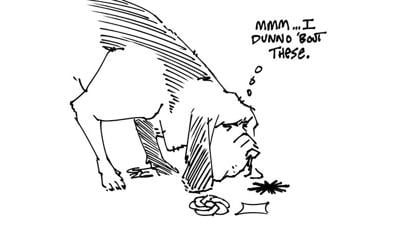
Finally, does it pass the sniff test? In your gut, do you believe what is being told to you is accurate? Put that critical-thinking cap on and verify your sources. Double-check the information with another news source and with your family and friends.
While I don’t have all the answers on AI, I at least have the tools to verify information and determine legitimacy. In fact – we all do! It’s called having a human brain, and that’s something AI can’t take away from us.