


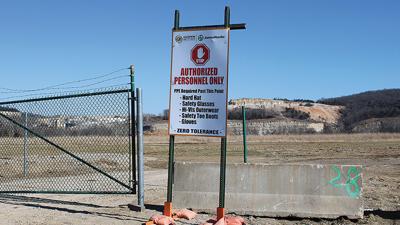
Public Water Supply District No. 12 has agreed to settle with James Hardie Building Products Inc., allowing the manufacturer to detach from the district and instead receive water from Crystal City.
While Crystal City voted to annex the James Hardie property in 2022, Brad Bryant, district manager of PWSD No. 12, said the property still lies within his water supply district’s geographic boundaries – along with about 17 other homes and businesses along Airport Road.
Bryant said his board felt confident the district would have won the lawsuit in the long-term but didn’t have the financial resources to continue litigation. He said the settlement was agreed on in June.
“We didn’t want to spend any more of our ratepayers’ money,” Bryant said. “They (James Hardie) paid us $150,000, which more than covered our attorney’s fees, and their property is no longer in our district.”
Crystal City Mayor Mike Osher said on July 16 that he wasn’t privy to all the details of the settlement agreement, and there are no immediate plans with James Hardie to begin supplying water to its Crystal City site.
“(The agreement) is just one more domino that needs to fall to bring all those manufacturing jobs and a great corporation to the county,” Osher said. “I’m absolutely excited for it, and I can speak for the (Crystal City) Council, we’re all excited for James Hardie to come to town.”
State and local officials announced in October 2022 that James Hardie is planning to build a 1.25 million-square-foot facility on and around the former Festus Municipal Airport property in Crystal City to manufacture fiber cement, siding and trim and other building products. The facility, off Airport Road, is expected to create about 230 jobs.
Mackenzie Smith Ledet, government relations director with James Hardie, previously said PWSC No. 12 “has been the obstacle” in opening the international home supply manufacturing company’s facility in Crystal City.
Smith Ledet claimed the water supply district has told James Hardie it “does not service our site, has never serviced our site and does not want to service our site,” leaving the manufacturer without a source of water for production.
At a Feb.10 state Senate committee meeting, Byrant refuted the claim.
Neither the water supply district nor Crystal City has infrastructure in place to pipe water to the manufacturing site, he said. No matter what entity James Hardie chooses, Bryant said, they would have to build out pipe to the facility.
In early discussions with developers, Bryant said James Hardie would require about 1.2 million gallons of specially treated water daily for operations.
The litigation with PWSD No. 12 was expected to lead to months more delays in development for James Hardie, Smith Ledet said, and so James Hardie supported a bill in the Missouri Legislature that would have sped up the detachment process.
State Sen. Mary Elizabeth Coleman (R-Arnold) introduced the bill in the Senate earlier this year, with Rep. David Casteel (R-High Ridge) of District 97 introducing a similar bill in the Missouri House. The bill would have made it easier for some landowners in a district to separate from the geographic boundaries of a public water supply district that does not currently supply water to their property. It was passed in the House but was not taken up for a vote in the Senate during the recent legislative session, which adjourned May 15.
Infrastructure projects
Smith Ledet said James Hardie is working closely with state, county and city officials to complete necessary infrastructure improvements around the future site of the facility, including roads, bridges and stormwater systems.
She said James Hardie expects the infrastructure work to be completed by late 2026 or early 2027.
Osher said he was confident Crystal City could handle James Hardie’s water demand. He said James Hardie is a water-efficient company, always working to modify its manufacturing process to save water.
“James Hardie is an eco-friendly company, so they’re constantly trying to modify their use and management of natural resources, and they do a great job of that,” Osher said. “I have not heard their latest requirements for water usage. I’m sure it’s much smaller than what it initially was. Whenever that does come about, we will absolutely have the capability of meeting what they need and providing for our residents, too.”
Osher said Crystal City draws its water from a massive, healthy aquifer, providing about 300,000 to 400,000 gallons of water per day to residents and businesses. He said the water plant is capable of producing a million gallons per day.
“When we built that plant, it was forward-thinking; it’s going to carry us for years and years,” Osher said. “Our residents are our number one priority. We have a duty to provide clean, safe drinking water to our residents, which I think we do on a great scale.”
Along with water infrastructure improvements, Osher said much work has been made to improve road, bridge and water drainage infrastructure around the James Hardie site.
“There have been so many players — the county, the cities, the state, and federal government — have all come together to make this possible in Jefferson County,” Osher said. “So, one more little thing that falls into place for us to move this project down the road, I’m absolutely excited for.”
The second part of Project Redbird, a multi-governmental effort to improve the transportation network around the James Hardie manufacturing plant, will be completed later this year.
Jefferson County, which is overseeing the project, used a $7.2 million grant from the Missouri Highways and Transportation Commission that was included in the 2024 state budget to help pay for the Phase 1 construction costs. The county was required to provide a 100 percent local match for the grant and designated $7.25 million in federal American Rescue Plan Act funding for the project back in 2020.
Phase 1 was completed in December 2024, when construction crews rebuilt the aging and crumbling Airport Road and portions of Castle Acres Road, River Cement Road, and Calvary Church Road, near Mercy Hospital Jefferson, to withstand heavy industrial traffic.
Another $12 million was set aside in the state budget for Phase 2.
Phase 2 is broken up into two parts, north and south of Plattin Creek, and expands on the improvements made in Phase 1.
In the northern part of Phase 2, Goodwin Brothers Construction crews are working to rebuild a portion of VFW Drive, from the St. Pius Spur to just beyond the Jefferson Memorial VFW Post 3777, 900 VFW Drive, and raise the road above the floodplain.
In the southern part of Phase 2, Goodwin Brothers will connect Calvary Church Road to Castle Acres Road, creating a new outer road that will connect to River Cement Road.
The largest part of South Phase 2 will be constructing a 235-foot bridge over Plattin Creek on the new portion of the outer road.
Still to be completed is the final part of Project Redbird, Phase 3. At the southern end of River Cement Road, where it meets Hwy. 61, a roundabout will be constructed to allow traffic to safely merge onto the highway.
The new outer road and roundabout will give heavy vehicle traffic coming from the James Hardie site another way to access Hwy. 61 and I-55, according to county officials.
The estimated completion date for Phase 3 is summer 2027, according to the county’s website.