


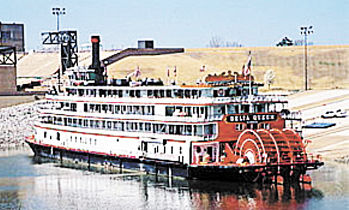
Kimmswick may be in line to be a base of operations for a riverboat cruise service that would travel the Mississippi and other rivers.
Patrick Lamping, executive director of the Jefferson County Economic Development Corporation, and Dennis Gannon, president of the Port Authority’s Board of Directors, confirmed that the two agencies are negotiating with Delta Queen Steamboat Co. LLC (DQSC LLC) to bring the historic steamboat, whose history dates to 1927, to make Jefferson County its home port.
“At this point, are we working with a company called DQSC LLC? Yes we are,” Lamping said. “Are they interested in Jefferson County? Yes. I believe they’re very interested in Jefferson County. What is the project? I can’t say a lot other than they own an excursion vessel that cruises the Mississippi River and Ohio River system.”
Gannon said the talks are ongoing.
“We have had communication with them, as recently as this past week. They did say they would continue to stay in touch, but there are other communities that are also interested in working with them. Until they get it nailed down, there’s not a lot to talk about.”
Cornel Martin, president and CEO of DQSC LCC, said his company is looking at a number of areas for the Delta Queen’s base of operations, but that Kimmswick is in the mix.
“Kimmswick is definitely one of the options, yes, indeed,” he said. “We’re also looking at Cincinnati, which was the Delta Queen’s original home port, New Orleans, and Baton Rouge (La.) has expressed strong interest.”
While downtown St. Louis has been mentioned as another possible site, Martin said Kimmswick is a more likely contender for the home port.
“We’ve talked with St. Louis, but the people representing Kimmswick have been a lot more aggressive than St. Louis,” he said. “If we’re looking at this region, Kimmswick would be several lengths ahead of St. Louis, talking in terms of a steamboat race.”
Martin said his company bought the boat, which is listed on the National Register of Historic Places, in February and is now looking for a site from which to base its operations.
He said the Delta Queen would run trips that would last three to 10 days.
“Cruises would start and end at several ports – New Orleans, Cincinnati, Pittsburgh, St. Paul, Minn., Arkansas and Galveston, Texas. But we’re looking for a home port where we would dock the vessel and also establish our corporate headquarters.”
Martin said he and his partners don’t have a timeline to choose that site.
“We’re still a ways from having to choose a specific site,” he said. “Probably our best-case scenario to start (cruising) operations is late spring or early summer of 2016.”
Jefferson County Council chairwoman Renee Reuter (District 2, Imperial) said the Kimmswick area is poised to compete well, because the county owns 46 acres along the Mississippi River there. That land was donated to the county for use as a park or recreational facility in 2003 by Kimmswick Properties Inc., a group of Jefferson County residents who had arranged to sell it for a proposed casino that never materialized.
Reuter visited the Arnold City Council’s March 12 work session, asking city officials to draft a letter to Gov. Jay Nixon requesting him to release $500,000 in the current state budget to fund port activities in Jefferson County.
The County Council and County Executive Ken Waller also have sent letters to Nixon.
“The County Council’s position is simply to help the Port Authority obtain the tools to bring economic development to Jefferson County,” Reuter said. “I am happy that the county executive, Jefferson County’s state legislators and the City Council and mayor of Arnold stands with the council in this request.”
Reuter said if Kimmswick is chosen by the Delta Queen’s owners, Arnold would stand to benefit.
She said some of that $500,000 could be used by the Port Authority to acquire some of the county-owned land in Kimmswick for the Delta Queen project.
“The Port Authority has said it is interested in making an offer to the County Council to consider, but they haven’t given us the details of what that offer may be,” she said.
Lamping cautioned that the money that Nixon is withholding isn’t necessarily tied to the Delta Queen proposal.
“These funds are to primarily be used for capital improvements and land acquisition,” he said. “This project doesn’t necessarily require the acquisition of land, although it could.
“We simply asked (the County Council) for consideration that matching funding might be placed in the county’s 2016 budget for capital improvements. Is this thing (the Delta Queen project) a sure thing? No, no, no. It’s quite a ways off.”
Reuter said in any case, it will help the county if Nixon would release the port money.
“I can’t say exactly how the Port Authority would spend that money,” she said, “but the county is trying to get a big project, and a half-million dollars is being withheld from us – that surely will have a detrimental effect.”
Delta Queen’s long history
Martin and his partners closed on the purchase of the Delta Queen in February from TAC Cruise LLC. The boat is now in Chattanooga, Tenn., where it was used as a floating hotel, bar and restaurant from 2009-2014, but Martin said it will soon be moved to Louisiana for extensive renovations and repairs to equip it for its return to being a traveling boat.
“We expect she’ll be in Louisiana for six to eight months,” Martin said.
He has said the refitting may cost as much as $7 million.
However, for the Delta Queen to be allowed to cruise the rivers again, Congress will have to pass an exemption to the federal Safety of Life at Sea law.
“Congress passed that law in 1966 in response to an ocean-going cruise vessel that was made of wood that caught on fire,” Martin said. “A lot of people died. The law says that only vessels made of noncombustible materials could carry people on overnight excursions.”
The Delta Queen is constructed of wood and has a steel hull. “At the time, the Delta Queen was the only inland steamship that was affected and no one thought of that when they passed the law,” Martin said.
“It was immediately granted an exemption and those were continually renewed until its owners at the time allowed the exemption to expire.”