


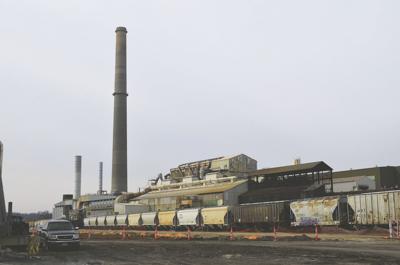
The Doe Run Co. plans this year to start demolishing the five main buildings that made up its Herculaneum smelting operation, as well as the 11 remaining houses from the company’s voluntary buyout program.
But the 550-foot-tall stack that dominates Herculaneum’s landscape will remain, at least for now, said Chris Neaville, Doe Run’s asset development director. The final days of the lead industry in Herculaneum are counting down in an enterprise that has endured in the city, first as St. Joseph Lead Co. and then as Doe Run, for more than 120 years.
Doe Run closed its smelting operation in 2013, but continued to operate its Herculaneum refinery, alloying and casting products from imported lead and recycled lead.
That work will cease in 2017, moving to the company’s Boss plant.
Doe Run’s Herculaneum property will be redeveloped for potential use as a port industrial park, Neaville said.
The Herculaneum lead smelter opened in 1892, producing lead from raw ore. Doe Run shut down the smelting operation about three and a half years ago as part of a comprehensive settlement with the federal Environmental Protection Agency and the state of Missouri.
There are no more lead smelters in the United States, Neaville said.
“Herculaneum was the last one,” he said.
All ore is now sent overseas on barges for the smelting process, Neaville said.
Relocation
At the start of 2013, Doe Run employed 290 people at its Herculaneum smelter. When the smelter closed, the number shrank to 40 employees to operate the refinery, and if things go as planned, only a handful of employees will remain to work at the site.
At the Boss Resource Recycling plant about 13.5 million lead acid batteries are recycled each year. Now Doe Run will transfer Herculaneum’s refinery operation to Boss.
“We’re modifying the plant there,” Neaville said. “Our hope is to have it completed this year.”
The timeline for closing the Herculaneum plant is contingent on when the Resource Recycling plant is ready for the new operations.
“As a part of the transition to relocate the refinery, we will follow a job posting process that allows employees from Herculaneum to apply for openings in other divisions,” Doe Run spokeswoman Tammy Stankey said.
Neaville said long-term remediation and maintenance will be required in Herculaneum.
“There are some environmental jobs that will remain,” he said. “We’ll have a crew on site for a number of years.”
Stankey said it has not been determined how many people will be needed for that work.
Demolition
Doe Run is currently cleaning up buildings in preparation for demolition, Neaville said. The five main buildings that make up the smelter are slated to be taken down, including the sinter plant, blast furnace, refinery, and two primary bag houses, he said.
Numerous other buildings– administration and office buildings – will remain on the site.
Although the demolition is scheduled to begin this year, it will take another year to take down all the buildings, Neaville said.
The tall stack at the site that is so easily identified with Doe Run, however, will remain for the time being, Neaville said.
“The stack is being left for now for the possibility of it being used in the future by a new business,” he said.
At 550 feet tall, the stack, built in 1996 and commissioned in 1997, is probably the tallest structure in Jefferson County, Neaville said.
Jefferson County 911 Dispatch’s tallest tower is 495 feet tall, 911 Chief Travis Williams said.
In addition to the smelter, the last 11 houses purchased through the voluntary buyout plan also are slated to come down this year.
The voluntary buyout was initiated in 2002 when lead levels in soil around homes near the plant were found to be at dangerous levels. To date, 150 homes in Herculaneum have been demolished.
Assumption Catholic Church, formerly at 329 Station St., was purchased by the company in July 2016 and was taken down and hauled away Jan. 19, Neaville said
“We purchased all the church property – the church, the rectory and the school,” he said. The rectory also was demolished.
“We’ve chosen to keep the school building for now. It’s a good brick building and could possibly be repurposed,” Neaville said.
Redevelopment
Doe Run is midway through its 10-year redevelopment plan for Herculaneum. The plan was announced in 2012.
“We implemented phase one when we opened the port,” Neaville said.
The 18-acre parcel that now serves as a port was sold to Riverview Commerce Park (RCP) – a partnership of Environmental Operations Inc., J.H. Berra Construction and Fred Weber Inc. – through a lease-purchase agreement early in 2013.
Today, two barge fleeting operations are located on the river at the site.
Doe Run owns 700 acres in the Herculaneum area. The company plans to remediate and redevelop 200-300 acres of it into a port industrial park.
Neaville estimated it will take three to five years to remediate the property after demolition.
The site will be remediated by capping the site with soil, and developing on top of it, he said. Environmental Operations Inc. will be the contractor for the demolition and remediation.
Neaville would not comment on the cost of the remediation because work is open to competitive bid and is confidential.
He said plans call for a “multi-modal port,” with access to various modes of transportation.
Herculaneum will be an excellent site for any industry that requires transportation, he said, because it is near a good highway system, has access to the railroad and offers a barge fleeting operation on the river.