


Pickleball is sweeping the county, state and nation. We should have figured it would.
Baby boomers, that proud group of Americans often characterized as the lump in the middle of the (population graph) boa constrictor, are looking for some kind of sport they actually can do.
That’s because the boomers, usually defined as those born between 1946 and 1964, have all turned 50. In fact, 50-year-olds are the youngest boomers. At the far end of the snake chart, they’re getting ready to turn 70 next year.
Not many of those 1946-vintage boomers are willing to admit to being old (you know who you are, Bro). They may not, but their aching knees, out-of-line hips, tennis elbows, stiff shoulders and kinked necks might, assuming we were able to interview individual body parts.
If horse racing is the sport of kings, pickleball may well turn out to be the sport of kinks.
The boomers were defined by their ever-present youth culture, not lab cultures of their latest medical issue, so it figures that they would embrace anything to continue the appearance of youth.
Last week the Festus City Council heard an update on a project to convert the former skateboard park at Jokerst Park on South Mill Street into pickleball courts. The proposal has the blessing of the Festus Park Board.
When Leader reporter Kevin Carbery called local pickleball enthusiast Jim Berger to get more details, he answered a couple of questions but apologized and cut the interview short – he had to go referee a pickleball match.
Sweeping the nation!
Berger later told Carbery that the Festus facility would be the largest pickleball-only venue in the St. Louis area.
The sport also has broken out at the Jefferson County Family YMCA, the Arnold Rec Center, the Cedar Hill Elks and at other venues across the county.
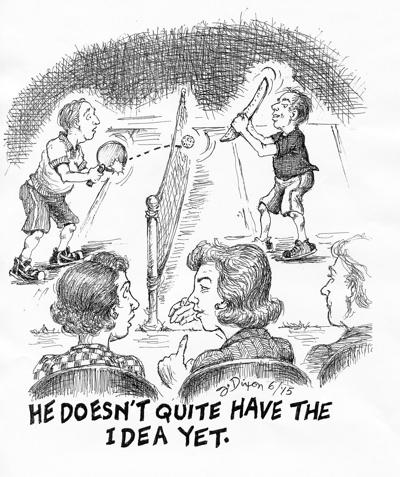
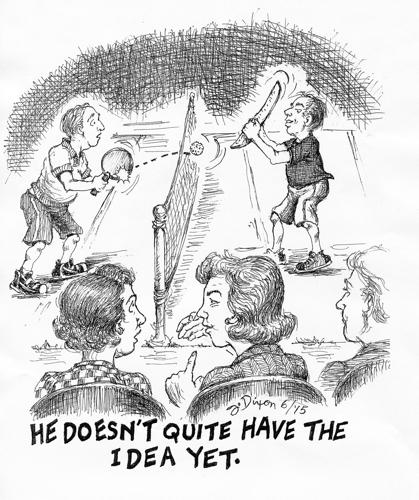
It appears to be a pretty simple game, a cross between tennis and ping-pong. Think of a tennis court, but shrink it to about a third of its normal size. Players use short-handled paddles that are bigger than ping-pong paddles but smaller than tennis rackets.
The ball is plastic and has holes in it. It travels at about one-third the speed of a tennis ball.
These refinements have to be appealing to baby boomers. There is far less court to cover than in tennis, which puts less stress on boomer ankles, knees, hearts, etc. Boomers have a better chance of seeing and hitting the slower-moving ball, or at least defending themselves from it. The game is fast, but not too fast.
Surely, you might say, this game had to be invented for the baby boom generation and its increasingly limited mobility.
In reply, I would say, “Don’t call me Shirley,” and besides, you’re wrong.
According to the USA Pickleball Association (USAPA), the game was invented in 1965 by a late congressman from Washington state, Joel Pritchard, and a neighbor, Bill Bell.
The two men had returned to Pritchard’s home after a round of golf and found their families “sitting around with nothing to do.”
There was an old badminton court on the property, so the men scrounged up some rackets and a plastic ball. After some experimentation with the height of the net, they refined the rules and came up with pickleball.
The USAPA story doesn’t detail it, but I can just imagine their bored teenagers rolling their eyes and ignoring these inspired inventors as they went about trying to entertain the little snots.
And teenagers in 1965, of course, would have been baby boomers, even though the term hadn’t been invented yet.
Ah, the irony. Fifty years later, those little brats are now old brats embracing what their younger selves scorned.
The game grew like a Northwest woods wildfire, with tournaments and rules and corporations. In 1984, the USAPA was formed. By 1990, the game was being played in all 50 states. Today, it is international.
So, why call it pickleball?
Both of the inventors are deceased, but there are two possible explanations, according to the USAPA.
Joel Pritchard’s wife, Joan, said she started calling the game pickleball because “the combination of different sports reminded me of the pickle boat in crew where oarsmen were chosen from the leftovers of other boats.”
The other explanation is a bit less highfalutin’.
Barney McCallum, a family friend who helped develop the game, said the game was named after the Pritchards’ dog, Pickles, who frequently would grab the ball and run off with it.
Either way, no actual pickles are needed or used in the game.
If someone tries to tell you otherwise, know that they are just gherkin you around.